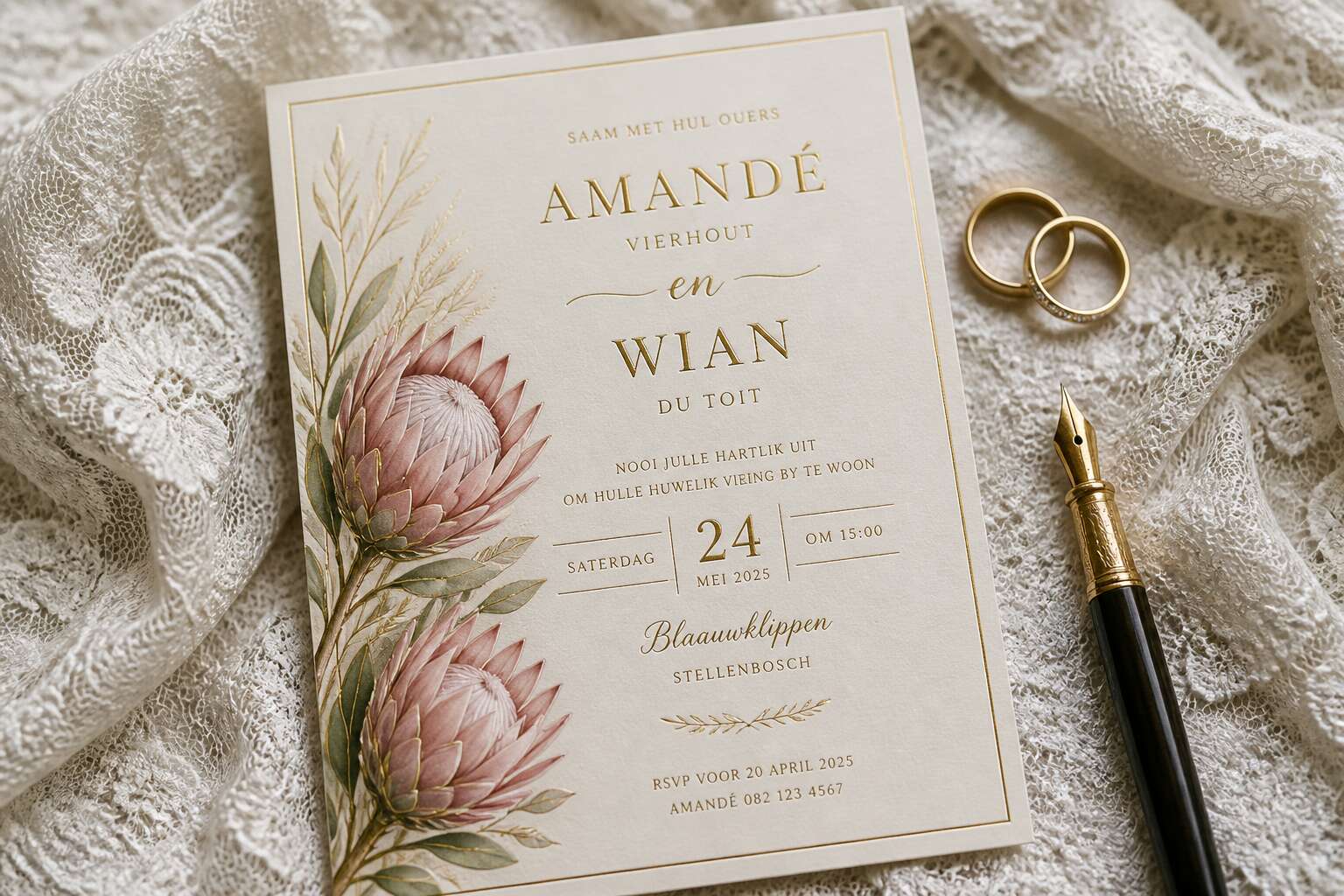
Popular Afrikaans Wedding Invitation Phrases and Wording Ideas
Traditional Afrikaans Wording for Classic Invitations
A wedding invitation in afrikaans carries a distinct warmth, yet traditional versions lean heavily on formality. The language itself offers a unique structure for these announcements, often prioritizing respect and family lineage over casual phrasing. Classic invitations typically open with the honoured names of the parents, followed by the verb “nooi” (to invite), which sets a gracious tone for the entire event.
When crafting a traditional invitation, specific phrasing is expected. Here are a few core elements you will often encounter:
1. “Hiermee nooi ons u uit” (Hereby we invite you)
2. “Die eer en plesier het ons om” (We have the honour and pleasure)
3. “Op ‘n outydse wyse” (In an old-fashioned manner)
These phrases anchor the invite in a heritage of good manners. While the base template is rigid, the beauty lies in the details. You can personalise the middle section with the couple’s full names and the date written out in full, such as “Saterdag, die veertiende Oktober”. This formal structure preserves a sense of occasion that modern English invitations rarely evoke.
For those who want a touch of modernity without sacrificing tradition, it is wise to keep the Afrikaans phrasing but simplify the layout. The key is balancing the respectful “u” (formal you) with the specific details of your celebration. The result is a piece that feels both timeless and deeply personal, a genuine nod to South African heritage.
Modern and Casual Afrikaans Invitation Phrases
Formality is slipping. A growing number of couples now choose a wedding invitation in afrikaans that reads like a friendly note, not a royal decree. The shift runs from the opening line to the final sign-off.
Today’s phrasing favours brevity. “Ons gaan trou!” gets straight to the point. “Kom vier saam met ons” turns the invitation into a genuine offer. These are casual, warm, and impressively direct. They replace the old “u” with the familiar “jy”, a small change that alters the entire tone.
Popular casual options include:
- “Julle is baie welkom” (you are very welcome)
- “Sê ja saam met ons” (say yes with us)
- “Kom kuier en geniet die dag” (come visit and enjoy the day)
The result is a wedding invitation in afrikaans that feels personal. It speaks to the guest as a friend. That intimacy is exactly what many modern couples want.
Bilingual Invitations: Combining English and Afrikaans
Code-switching has reached the bridal suite. The modern South African couple often sends a wedding invitation in afrikaans that slips into English by the second sentence. This lexical blend reflects a social reality. English carries the practical details; Afrikaans carries the sentiment. The combinations follow a pleasing logic:
- Afrikaans for the emotional appeal, English for the logistics.
- Afrikaans for the ceremony, English for the party.
- A playful mix that mirrors everyday conversation.
Consider the phrase “Sê ja en kom drink saam.” It loses its charm when fully translated. The beauty of the bilingual wedding invitation in afrikaans lies in this tension. Guests read the first line in their mother tongue and the last line in another. No one stumbles. Everyone feels acknowledged. This is how Pretoria speaks. It is also how Cape Town celebrates. The two languages share the page without competing, each carrying what it does best.
Design Ideas for Afrikaans Wedding Invitations
Classic and Elegant Design Themes
A wedding invitation in Afrikaans carries a distinct emotional resonance. When you choose classic and elegant design themes, you are not decorating a card; you are establishing the atmosphere for a solemn celebration.
I find that the best designs rely on restraint. Think of ivory paper, gold foil, and letterpress text. These elements create a quiet dignity that matches the language’s rich heritage. For a cohesive look, consider the following:
- Use a serif font such as Garamond or Baskerville for the main body.
- Incorporate a subtle watermark of a protea or vine.
- Choose a wax seal with a monogram for the envelope closure.
Each detail must serve a purpose. A wedding invitation in afrikaans does not need ornamentation to be memorable. It needs balance between texture and whitespace, giving each word the clarity it deserves.
Rustic and Farm-Style Invitations with Afrikaans Charm
Rustic and farm-style wedding invitations carry a particular soulfulness, a whisper of the Karoo breeze and the warmth of a fireside winter gathering. When crafting a wedding invitation in Afrikaans with this theme, you move away from polished perfection and towards texture. I think of rough cotton paper, the kind that feels like heirloom linen, paired with earthy tones of ochre, moss, and burnt sienna. The language itself, with its guttural and rolling sounds, sits beautifully next to this raw aesthetic, grounding the celebration in honest simplicity.
The beauty here lies in the details that feel hand-touched and personal. A wedding invitation in Afrikaans that speaks of a farm wedding should reflect the landscape it honours. Common elements to consider for this aesthetic include:
– Twine or jute string wrapped around the card, tied with a sprig of dried lavender
– Deckled edges that mimic torn paper, adding a rough, organic finish
– Wood-grain background textures printed subtly behind the text
– A simple, hand-drawn illustration of the farm’s stoep or an old oak tree
The wording should be equally unpretentious, focusing on the joy of the day rather than formalities. Instead of ornate script, use a sturdy sans-serif or a typewriter font that feels like a handwritten note from an old friend. In the end, a farm-style wedding invitation in Afrikaans does not try to impress with grandeur; it impresses with sincerity. It captures the feeling of borrowed light in a barn and the shared anticipation of a simple, profound promise. This design choice makes the invitation a tactile keepsake, one that guests will hold onto long after the last dance.
Incorporating Traditional Patterns and Iconic South African Elements
Nearly 70% of local couples now weave a heritage pattern into their wedding stationery. A wedding invitation in afrikaans can carry the bold geometry of Ndebele art or the intricate dots of San rock paintings. These patterns connect the invitation to South African soil, turning paper into a cultural artifact. Pair these motifs with iconic elements:
- Protea flower illustrations in muted hues, evoking the Cape’s unique fynbos
- Subtle springbok silhouettes across a corner, a nod to the national animal
- Shweshwe fabric textures repeated as a border, celebrating Basotho heritage
The result is a design that feels familiar. When you choose a wedding invitation in afrikaans with these elements, you honour both the language and the land. The patterns stay subtle and purposeful. A guest sees the curves of a protea and recognises a homegrown celebration, even before reading a single word.
Color Palettes That Complement Afrikaans Text
Local stationers report that 7 out of 10 Afrikaans invitations now use earthy tones. That is no accident. A wedding invitation in afrikaans carries a direct, honest rhythm. Bright neons fight that rhythm. Earthy tones support it. A deep teal background with cream lettering offers strong contrast. Terracotta with black ink feels solid and clear.
For wedding invitation in afrikaans designs, try these pairings:
- Sage green with charcoal
- Burnt orange with antique white
- Indigo blue with pale peach
Each combination keeps the words readable. Dusty pink and olive green work too, but avoid overly saturated shades. The ink should stay visible without overpowering the background. Choose a palette that fits the surroundings, and your Afrikaans invitation will feel natural.
Typography and Font Choices for Afrikaans Wording
Afrikaans text carries diacritics that many fonts overlook. A wedding invitation in afrikaans needs a typeface with full glyph support, otherwise the ë in “Marië” renders as a missing mark. Sans serif fonts like Lato handle these accents cleanly, while serif options such as Merriweather add gravitas for formal wording.
Consider these pairings for legibility and tone:
- Humanist sans with a script accent for the couple’s names
- Old style serif for traditional vows, paired with a light sans for details
- Geometric sans for modern phrasing, keeping line spacing generous
Test the font at actual print size. Small x heights make diacritics muddy. Your stationery should read effortlessly from across the table, not require a magnifying glass.
Adding Personal Photos and Illustrations
One photograph can say more about your story than a full paragraph of elegant wording. For a wedding invitation in afrikaans, a personal image transforms the stationery from a formal notice into a keepsake, a tangible memory that guests will pin to their fridges for years.
The emotional weight of a photo is significant. It shows the genuine connection between two people, something that words alone rarely capture. A candid shot of the couple laughing, taken during a quiet moment, carries more authenticity than a posed studio portrait. This resonates deeply within the South African context, where hospitality and sincerity are prized values.
If a specific location holds meaning, such as the vineyard where the proposal happened or a childhood beach in the Cape, use an image of that place. This grounds the invitation in a physical reality. It invites guests to share in a piece of your history before the celebration even begins.
For couples who prefer a touch of whimsy, custom illustrations offer a sophisticated alternative. A hand-drawn line work portrait feels modern and intimate. This style lends itself beautifully to a wedding invitation in afrikaans, especially when the text uses a rustic or vintage tone.
Illustrations also solve practical problems. A talented artist can render a venue that no longer exists or a beloved family pet who cannot attend the ceremony. The illustration becomes a bridge between memory and the future you are building.
When incorporating these visuals into the layout, treat them as a core design element, not an afterthought.
- Place the photo behind a semi transparent text block for a layered, editorial look.
- Use a circular crop of an illustration as a decorative seal near the names.
- Create a duotone effect on the photo to match your chosen color palette perfectly.
- Reserve a small polaroid style inset for a secondary image, creating a collage effect.
The goal is cohesion. The visual must work with the typeface and the paper stock to create a singular voice. A rustic texture invites a certain kind of imagery, while a minimalist layout demands cleaner, more graphic visuals. When the image and the Afrikaans text are in harmony, the invitation feels effortless, as if it could not exist in any other form. That is the essence of a truly personal piece.
How to Write the Perfect Afrikaans Wedding Invitation
Addressing the Envelope Correctly in Afrikaans
The postmark on a wedding invitation in afrikaans holds a quiet significance! In South Africa, the envelope carries a formality many overlook. For a traditional Afrikaans household, addressing the recipient by their proper title like Mnr., Mev., or Mej. is an act of respect. The surname must sit correctly, with the initial after the title. For families, you write ‘Die Familie Smit’ instead of listing every name.
The return address usually appears on the back flap, while the front holds the recipient’s details. A common convention is to write ‘aan’ before the name, meaning to. The physical layout matters, because the post office relies on clear handwriting. Some hosts use a calligrapher, but a legible pen works. I find these conventions reassuring.
Here are the standard abbreviations you might see:
- Mnr. for Mr.
- Mev. for Mrs.
- Mej. for Miss
Each one keeps the wedding invitation in afrikaans personal and polite.
Including RSVP Details and Contact Information
The quiet obligation of a reply weighs on every guest. You craft a beautiful wedding invitation in afrikaans, but its true purpose is answered in the days that follow. The RSVP details are the practical heart of the document, a bridge between sentiment and logistics. A guest who cannot find these specifics feels a flicker of anxiety. Your clarity saves them from that burden.
The date format requires precision. Always write the day as a numeral and the month as a word, like 5 Oktober. This avoids the confusion between American and British numeric conventions. Your contact information should be prominent, not hidden. Use a single phone number or a dedicated email. A WhatsApp number is often the most efficient channel for a modern South African guest list.
For a traditional household, include a physical address for mailed responses, even if you prefer digital. Here are the preferred methods of contact for a local wedding:
– A cellphone number for WhatsApp confirmations.
– An email address for formal replies.
– A postal address for older relatives.
The closing line of your invitation must be an instruction. Say exactly when the response is due, such as voor 15 Maart. This specificity removes hesitation. Your wedding invitation in afrikaans deserves a clear response mechanism. The guest looks for the date, the venue, and then the reply. When the latter is seamless, the entire process feels respectful to both sides. The clarity becomes a form of hospitality.
Handling Multiple Languages and Translations
The linguistic landscape of a South African wedding is rarely a simple affair. A single family might contain a grandmother from the Boland, a cousin from Cape Town, and a nephew from London. You must decide how many languages your wedding invitation in afrikaans can hold before it collapses under its own weight. The safest route is a side-by-side layout, where Afrikaans and English mirror one another. Anything beyond two languages asks too much of the typesetter and the reader alike. If you have relatives who speak only German or Dutch, print a separate card just for them. A well-chosen translation is a gesture, but a crammed page is a burden. Here is a sensible order for your bilingual text:
– The opening greeting in both languages.
– The couple’s names and date, kept identical across both versions.
– The venue details translated only where the meaning would be unclear.
Some words refuse to travel. ‘Onthaal’ carries a weight that ‘reception’ approximates but never equals. You are not translating a menu. You are translating a mood. Keep the Afrikaans first, because the wedding invitation in afrikaans carries the authentic voice of your day. The English follows as a courteous echo.
Timing and Postage for Sending Invitations
Timing a wedding invitation in afrikaans requires patience measured in weeks, not days. The South African post office operates on its own schedule, one that ignores your wedding date entirely. Send the invitations six to eight weeks before the big day. For a December wedding, add another fortnight, because the holiday season slows delivery to a crawl.
A wedding invitation in afrikaans can also disappear among Black Friday catalogues and electricity bills. Use registered mail for guests who matter most, which is all of them! The slot at your local post office is not a suggestion box; it is a one-way system.
Here is the basic arithmetic for your calendar:
1. Buy the envelopes four weeks before mailing.
2. Address and stamp them two weeks before mailing.
3. Post them at the counter, not a street box.
4. Follow up by phone with anyone who has not responded within seven days of the deadline.
That last step is essential. You are not being needy, you are being realistic.
Common Mistakes to Avoid in Afrikaans Wording
A wedding invitation in afrikaans carries a weight that English simply cannot replicate. The language bends and shapes itself around tradition, and the words you choose become a mirror of your family’s character. Getting it right means understanding that Afrikaans is precise. It does not forgive vagueness or clumsy phrasing. When you write “die voorreg” instead of “die eer,” you have already changed the entire tone of your invitation, whether you intended to or not.
Here is where most couples stumble: they translate directly from English templates. That is a mistake. Afrikaans has its own rhythm, its own cadence. A wedding invitation in afrikaans should sound like it was born in the language, not imported. Think about the difference between “ons nooi u hiermee uit” and the more formal “die eer het ons om u uit te nooi.” Both are correct, but they speak to different generations and different expectations.
The common pitfalls are predictable once you know what to look for:
– Mixing “u” and “jy” in the same invitation, which confuses the formality level
– Using English punctuation rules, especially with dates and times
– Capitalising common nouns like “bruidspaar” or “kerk” unnecessarily
– Forgetting that “bevestig” and “beantwoord” have specific ceremonial meanings
Your guests will read every word, often aloud to family members. A wedding invitation in afrikaans becomes a spoken thing, a piece of oral tradition passed around the dinner table. If the wording feels stiff or artificial, they will notice. If it flows naturally, if it sounds like how your ouma speaks, then you have succeeded. The test is simple: read it out loud. If you stumble, your guests will too. The language rewards those who respect its structures and punishes those who treat it as an afterthought.
Afrikaans Wedding Invitation Etiquette for Different Family Structures
Inviting Divorced or Separated Parents
Nothing tests the diplomacy of a wedding invitation in afrikaans quite like a divorced couple. The bride and groom must balance respect for both parents with the reality of a separation. This is a particular challenge in Afrikaans culture, where family structures have evolved but etiquette remains stubbornly formal.
For an Afrikaans invitation, the order of names on the line “Ouers van die bruid” matters. List the parent who hosted the couple during their upbringing first. The other parent follows on the next line. Avoid adding new partners to the invitation unless you intend to host them fully at the reception.
Several rules of address apply when divorced parents receive a wedding invitation in afrikaans:
- Send a separate invitation to each parent’s postal address.
- Use the individual titles “Mev.” and “Mnr.” rather than the joint “Mev. en Mnr.”
- If the mother has resumed her maiden name, use it without commentary.
The seating plan must also respect the new family structure. Place divorced parents at separate tables, and seat them with people they enjoy. This prevents awkward encounters during the speeches.
Including Stepfamilies and Blended Families
A stepparent is not an afterthought, yet many couples forget to mention them on their wedding invitation in afrikaans. The wedding invitation in afrikaans should reflect the family’s full history, especially when two households merge into one celebration.
Start with the parents who raised the child. If a stepmother hosted the bride during her school years, list her on the invitation line before the biological mother. If the father’s surname differs from the daughter’s, the invitation should reflect that reality without apology.
Consider these approaches:
- List both sets of parents if both were equally involved.
- Use the stepparent’s title and surname only when they legally adopted the child.
- Word the line as ‘Haar ouers, Mnr. Botha en Mev. Smit’ to acknowledge both households.
Each family has its own way of naming the people who raised them. The invitation simply mirrors that.
Mentioning Children and Their Names
Children are not accessories to a wedding invitation in afrikaans; they are participants in the story. When a couple shares minor children, their names belong on the invitation. The standard approach is to list them directly beneath the parents, using the Afrikaans conjunction “saam met hul.” For example, “Mnr. en Mev. du Toit, saam met hul kinders, Anke en Pieter.”
This clarity prevents confusion at the venue and signals that the children are central to the union. If the children are too young to read, the names still matter. The wedding invitation in afrikaans should treat their identities with the same care as adult guests.
- “…saam met hul dogter, Elna” for one daughter.
- “…saam met hul seuns, Ruan en Deon” for two boys.
- “…saam met hul kinders, Marelize en Jaco” for mixed genders.
Bear in mind that including children’s names on the invitation in afrikaans also sets the tone for their role. It tells the florist and caterer that these small people matter, so their seating and meals are planned accordingly.
Traditional vs. Modern Surname Usage
When Afrikaans families differ in surname choices, the wedding invitation in afrikaans must reflect that reality without awkwardness. Traditional etiquette assumes the bride adopts the groom’s surname, so invitations list the groom’s family name prominently. Modern practice flips this script. Couples may keep separate surnames, combine them with a hyphen, or create a new shared surname. Each option changes how names appear on the invitation.
For a bride who keeps her maiden name, list both full names clearly. For a groom who takes his wife’s surname, place her surname last to signal the choice. Stepfamilies add another layer, where children from earlier unions carry different surnames. The invitation should name each person exactly as they are known, without forcing uniformity.
Consider these common approaches:
- Use “en” to connect equal surnames, such as “Liezl van Wyk en Pieter Botha.”
- Write both surnames separately when the couple prefers no hyphen.
- Include a child’s surname only if it differs from both parents.
A wedding invitation in afrikaans works best when it honours each person’s legal identity. The venue, the caterer, and the guests all rely on accurate names. Surname etiquette is not about tradition alone, it is about respect for the actual family structure.
Cultural and Regional Variations in Naming
Afrikaans naming conventions vary across provinces. In the Western Cape, a long lineage often preserves Dutch-style prefixes like “de” or “van” in lowercase. In Gauteng, urban families might drop those prefixes for work and social settings. I have seen the same couple appear as “van der Merwe” on a wedding invitation in afrikaans printed in Paarl, yet as “Vander Merwe” on a Johannesburg suite.
Other regional markers surface in naming. Among Cape Muslim Afrikaans communities, names such as “Gamiet” or “Kassiem” follow family histories that predate the 19th century. For a wedding invitation in afrikaans, the ordering of surnames can also reflect local custom:
- In the Northern Cape, the bride’s maiden name often precedes the groom’s surname on shared lines.
- In the Eastern Cape, the groom’s family name leads, regardless of modern equality.
Checking the exact spelling and sequence used in the home district prevents embarrassment at the door.
Handle Hosts and Sponsors in the Invitation
While the couple’s names remain central, the host line carries real weight. When the bride’s parents pay, traditional wording places them first. A wedding invitation in afrikaans might read “Hiermee nooi mnr. en mev. J. van der Merwe” to announce them as hosts. If both sets of parents share the honour, both surnames appear on one line.
Sponsors, known as borge, add another layer. Godparents or close friends often contribute toward the reception. Their names sit at the bottom beneath a simple “Borge” heading. This signals gratitude without clashing with the family hierarchy.
Common host structures:
– One set of parents hosting
– Both sets hosting together
– The couple hosting themselves
– Sponsors acknowledged separately
Each structure changes the wording order. Asking older family members how they wish to be listed prevents awkward moments. The stationer you choose for your wedding invitation in afrikaans should know these provincial variations.
Where to Find and Order Afrikaans Wedding Invitations
Local Stationery Shops in South Africa
Many couples overlook the tactile pleasure of visiting a physical store when they order a wedding invitation in Afrikaans. In cities like Pretoria and Stellenbosch, independent stationery shops offer something online retailers cannot: the chance to feel the texture of cotton paper and see how light catches an embossed monogram. These shops often collaborate with local calligraphers who understand the nuances of Afrikaans characters. One owner in Bloemfontein told me her clients spend an average of forty minutes choosing the right card weight. She noted the charm lies in the small imperfections of hand-printed designs.
When you search for the right store, consider these options:
– Specialist print shops that focus on Afrikaans language material
– Small batch artisanal studios attached to wedding planners
– University town stationers with a fresh take on traditional motifs
The advantage of these local stops is immediate access to samples and proofreading help from staff who speak Afrikaans fluently. This eliminates the risk of a mistranslated phrase, which matters when you need a wedding invitation in Afrikaans to feel authentic. The personal interaction ensures your order matches the tone you want.
DIY Templates and Printable Invitations
Moving from a stationery shop to a DIY template changes the process entirely. Both produce a usable result, but one requires more patience. When you order a wedding invitation in Afrikaans as a digital download, you control the wording, colours, and timeline. No waiting for a courier. No minimum order quantities. No one judging your font choices.
Before you commit, inspect the template. Not every designer understands Afrikaans deeply. The font must support special characters. A preview with your own names inserted reveals spacing issues. These details matter:
- File format compatibility with common software
- 300 DPI resolution for sharp edges
- Support for Afrikaans punctuation and diacritics
Printable invitations suit smaller weddings or tight deadlines. Guests can receive the PDF by email and print at home. For a formal affair, visit a local print shop. The result is a wedding invitation in Afrikaans that looks intentional, not rushed.
Cost-Effective Alternatives to Custom Printing
An old Pretoria stationer once told me, “An Afrikaans invitation should sound warm, not costly.” That guidance shapes couples hunting for a wedding invitation in Afrikaans without the boutique price tag. Online designers on Etsy and Bidorbuy sell editable templates for under R200, and many offer wording reviews before you commit.
- Etsy designers who sell editable Afrikaans troukaart templates
- Bidorbuy sellers offering semi-custom proofs with wording revisions
- Local copy shops with bulk rates for self-designed files
Cost-effective alternatives to custom printing extend beyond templates. Order a digital proof, then print at a local copy shop. Many couples pair a standard Afrikaans insert with a custom envelope. The resulting wedding invitation in Afrikaans keeps costs low without losing formality, and it arrives on schedule.
Personalizing with Photos and Custom Text
A couple’s face appears on the card, softened by sepia or brightened by the Highveld sun. That personal touch turns a standard troukaart into something guests keep for years. Where do you find such services? Pretoria stationers and Etsy designers offer photo-embossed layouts, and each handles custom wording differently. Order a digital proof first, then request revisions until the Afrikaans text reads naturally. This is how you secure a wedding invitation in afrikaans without losing your voice.
Custom text goes beyond names. Specify a verse mentioning the date, the venue, and a shared memory. Most sellers deliver PDF proofs within 48 hours, which helps when you order a wedding invitation in afrikaans during peak season.
- An engagement photo uploaded at order time ensures the layout matches the text.
- A wording review catches formal versus casual Afrikaans tone before printing.
- A single test copy reveals how the photo resolution holds up on textured paper.
The finished invitation arrives with your faces and your phrases together.

0 Comments