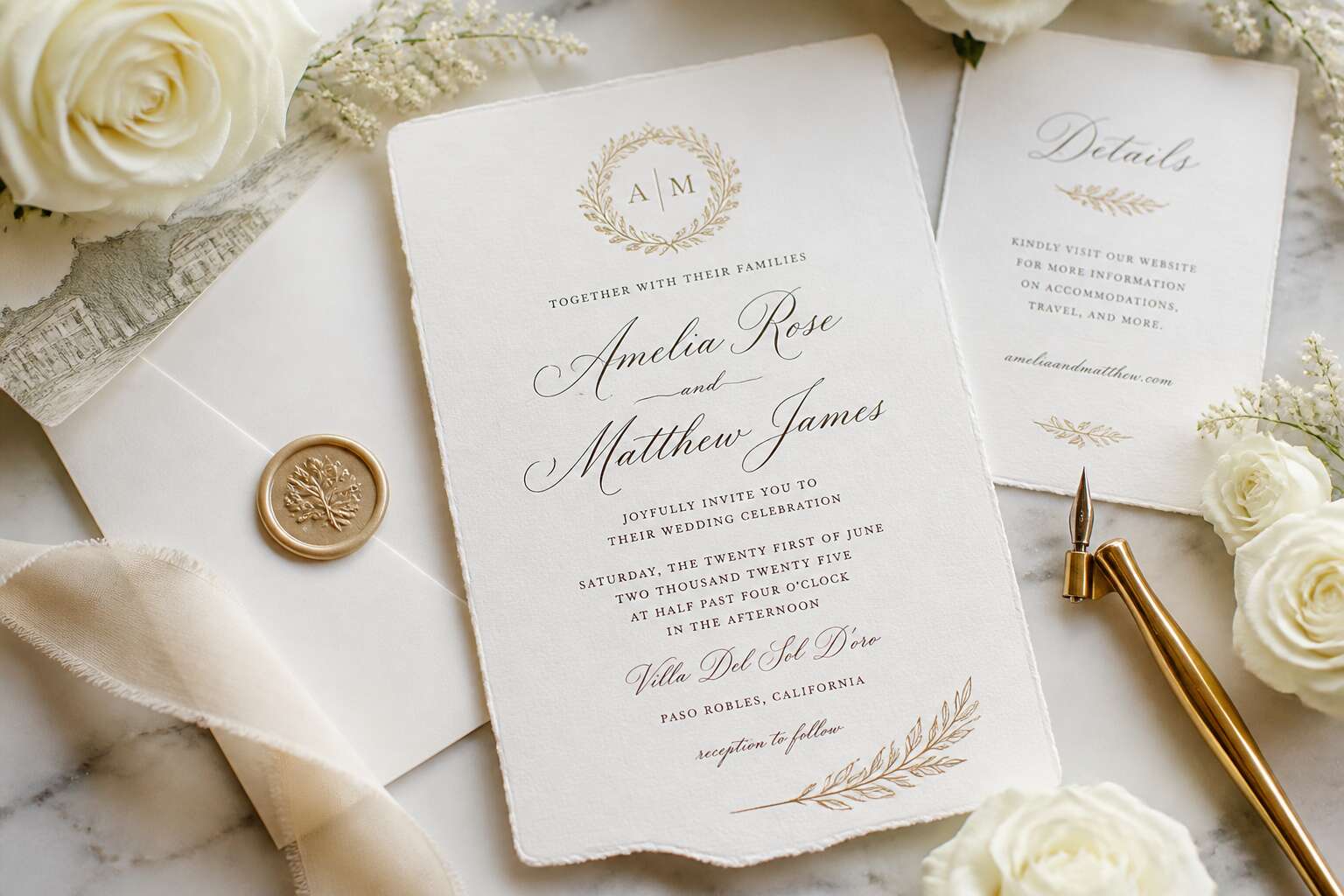
Key Components of Wedding Invitation Wording
The Importance of Set the Tone
Your wedding invitation greetings carry the first impression of your entire event. In South Africa, with eleven official languages, word choice matters even more. “Dear Guests” feels different from “Beloved Family and Friends.” The key components of wedding invitation wording go beyond names and dates. You need the host line, the request line, and the reception details. Each component sets a specific tone. I have seen invitations with zero personality, and the couple wondered why guests RSVP’d late!
Consider these core components:
- The host line: who is inviting, and in what voice?
- The request line: “request the honour of your presence” versus “invite you to celebrate.”
- The dress code: casual chic or black tie, stated without apology.
The importance of setting the tone cannot be overstated. A whimsical beach wedding needs a light touch, not a formal decree. Match your phrasing to the vibe, and your wedding invitation greetings will do the work before the caterer even arrives.
Differentiating Formal and Informal Language
Here is the uncomfortable truth about wedding invitation greetings: the phrase “together with their families” can make your great aunt assume a white tie affair, while “we’re getting hitched” signals a garden braai where dancing happens on the lawn. Choose your host line with care.
Formal requests demand “request the honour of your presence.” Informal requests suit “invite you to celebrate.” The dress code requires precision. “Smart casual” invites debate. “No jeans, no drama” invites compliance.
- The request line determines the ceremony’s perceived solemnity
- The host line establishes who is paying and who is merely surviving
- The dress code sets the anxiety level for every guest
Formal language creates distance and gravitas. Informal language creates warmth and energy. Mixing the two ruins your wedding invitation greetings, and confused guests RSVP late.
Special Instructions and Additional Lines
Special instructions deserve their own line, not a whispered afterthought. If you request an unplugged ceremony, state it plainly. If children are welcome after the first dance, say so on the card and again on your wedding website.
Additional lines carry the logistics guests need before they can commit:
- RSVP by 15 August
- Dietary requirements
- Accommodation blocks under the Botha family
- Parking notes for the venue
These details feel heavy, so your wedding invitation greetings should frame them lightly. A soft phrase like “we look forward to toasting with you” turns a request for dinner numbers into a warm invitation. Keep every instruction short, specific, and useful!
How to Address Your Wedding Guests Properly
Addressing Single Guests and Plus-Ones
Addressing single guests requires a careful eye. An unmarried guest should receive their own invitation, even when they share a home with friends or relatives. The outer envelope carries the full name, while the inner envelope can use a casual form. This simple rule preserves clarity without sacrificing courtesy.
Plus-ones present a separate challenge. When a guest is in a committed relationship, learn the partner’s name and write it on the invitation. Avoid the phrase “and Guest” when you know the partner. It feels impersonal. For truly unknown plus-ones, “and Guest” remains acceptable, but keep it on the inner envelope only.
Consider these common scenarios:
– A single friend with a long-term partner
– A colleague attending alone
– A guest whose partner you have never met
Each situation calls for the same principle: show respect through precise naming. These wedding invitation greetings should reflect genuine attention to each attendee’s circumstances.
Addressing Couples and Families
Married couples deserve equal treatment, even when one partner changes their surname and the other does not. The outer envelope should carry both full names on a single line. Dr. Thabo Nkosi and Ms. Lerato Molefe, for example, reads cleanly without forcing an assumption about naming choices.
Families with children require a different approach. Children over eighteen receive their own invitations. Younger children appear on the inner envelope beneath their parents’ names. In my experience, this small gesture reassures parents that their children are genuinely welcome.
A practical method for keeping order:
- List each family unit on a separate row in your spreadsheet.
- Match every child’s name to the correct parent.
- Verify ages before the final print run.
The best wedding invitation greetings treat each household as a single unit with individual members. These wedding invitation greetings reflect the same care you gave to the guest list. This courtesy prevents awkward conversations later!
Handling Friends and Distant Relatives
Every guest list holds guests on the borders of your life: the university friend you see once a year, the cousin who sends messages but never visits. Their absence would be noticed. Wedding invitation greetings for this circle require restraint.
Titles carry weight for older relatives, especially in South African homes where respect is woven into address. A distant uncle becomes Mr. T. Mokoena rather than Oom Piet, unless you already speak to him with that familiarity. For friends, simplicity rules.
- Use the full legal name on the outer envelope.
- Add the nickname in parentheses only when the person answers to no other name.
- Verify every surname against the last message you exchanged.
In my experience, distant relatives hold the invitation for weeks. The wording stays with them. Wedding invitation greetings that carry precise names tell these guests they are remembered. That memory matters!
Gender-Neutral and Inclusive Options
Nearly 20% of South African couples now request to be addressed without gendered assumptions. That number grows each year. People want their wedding invitation greetings to reflect who they truly are. The old rules of “Mr. and Mrs.” no longer fit every guest.
Names hold power. Getting them wrong creates distance. Getting them right builds intimacy. Your wedding invitation greetings should demonstrate that you see each guest clearly and respect their identity. The envelope is the first conversation you have with them.
Start with the honorific “Mx.” when you are unsure of a guest’s preference. It works in English and Afrikaans contexts. It bends toward no gender and stands firm in courtesy.
Consider the construction of your guest list. Families are not uniform. A friend may use their surname from a parent who is not biologically related. A surname may have changed during a transition. Verify each name through direct communication. The best wedding invitation greetings are built on accurate details.
– Write the guest’s chosen name in full. No shortening unless you know they prefer it.
– Place “Mx.” before the full name. “Mx. Thandi Nkosi” is respectful and precise.
– For couples, list both names on the same line.
– Use only the first name when the guest has stated a strong preference.
Full legal names on the outer envelope help with security at the venue. They also signal care. When a person opens the envelope and sees their exact name, they know the invitation was made for them. That moment creates goodwill. Your wedding invitation greetings can hold that warmth in a single line.
Some guests will ask why you included a title they did not expect. Explain briefly and move on. The courtesy matters more than the tradition.
Crafting the Perfect Opening Salutation for Invitations
Traditional and Classic Opening Phrases
A wedding invitation’s opening line is read twice, once by the recipient and again by every guest they share it with. That first phrase must carry the entire celebration, so choosing traditional phrasing grounds the piece in elegance. For wedding invitation greetings, time honoured salutations remain the safest path for couples seeking that foundation.
Classic openings use specific structures that signal formal celebration. “Together with their families, [name] and [name] request the honour of your presence” suits religious ceremonies. “Mr and Mrs Botha invite you to celebrate the marriage of their daughter” offers warmth while retaining propriety.
Other enduring examples include:
– “The pleasure of your company is requested…”
– “You are cordially invited to the wedding of…”
– “[Names] joyfully request the honour of your presence…”
These salutations create a gracious threshold between the couple and their guests, making wedding invitation greetings feel personal and polished.
Modern and Casual Greeting Lines
Seventy percent of South African couples now choose casual wording for their invitation suites. The numbers confirm what I observe in my work: wedding invitation greetings have grown warmer, more direct, and more personal. Casual openings like “Let’s drink, dance, and celebrate” or “We are tying the knot, join us” replace the old formalities.
A relaxed salutation still carries weight. It removes the barrier between host and guest. When you write “Come celebrate our marriage,” you are offering a genuine welcome. The greeting sets the tone for the entire event. If your wedding features live bands and barefoot dancing, let the invitation say so. The wedding invitation greetings you select should mirror the atmosphere guests will actually experience.
Including Children or the Whole Family in the Greeting
Children haunt the edges of every wedding. They scatter petals, hold rings, or simply sit wide-eyed through the vows. Yet the wedding invitation greetings that remember them are rare. I have opened countless envelopes where the little ones were omitted entirely, an absence felt more keenly than any oversight. In South Africa, where the family gathering stretches across generations and provinces, the opening salutation should name the whole household. A simple line such as “Together with our children, we ask for your presence” transforms the invitation from a formal notice into a true summons. It tells guests that the celebration will welcome noise, laughter, and the unsteady feet of small dancers.
Some couples prefer to weave the children into the greeting directly:
- “We, along with our two sons, invite you to celebrate our marriage.”
- “Our family of four requests the honour of your company.”
- “Come share this day with us and our children.”
The opening salutation should open wide enough for everyone. Write the names of the young ones beside your own, lifting them out of the fine print and into the light of the first line. That single gesture tells your guests that the whole family belongs to the ceremony, present from the very first word.
Cultural and Religious Salutation Traditions
In South Africa, the opening salutation is a map of belonging. With eleven official languages and a spectrum of faiths, no single greeting fits all. Zulu invitations often begin with “Siyakumemela,” while Afrikaans couples write “Ons nooi u hiermee uit.” Christian ceremonies might open with a benediction; Muslim invitations frequently start with “Bismillah”; Hindu weddings traditionally honour Ganesha. These wedding invitation greetings carry deep cultural weight, so the phrasing must be chosen with care.
Consider how religious traditions shape tone:
- Muslim salutations often include a blessing.
- Jewish invitations may reference a verse from the Torah.
- Christian couples sometimes weave in a prayer or scripture.
For interfaith or intercultural couples, the greeting can blend both heritages. The goal is to make every guest feel welcomed from the very first line.
Using Host Names in the Opening Line
Your invitation’s opening line is more than a formality; it is the first chord of the celebration’s song. Using host names in that first sentence handcrafts a direct connection with each guest. Rather than leaning on a generic phrase, consider how “Nosipho and Liam invite you to share their joy” instantly anchors the moment in real people. Among wedding invitation greetings, this approach spans from lavish to intimate.
Some couples choose to blend generations:
- Both sets of parents as hosts, followed by the couple’s names.
- Only the couple’s first names, for a modern, intimate feel.
- Full names including surnames, for a formal and traditional tone.
The choice reflects the wedding’s atmosphere. When you name your hosts, you transform the salutation into a personal handshake across the page.
Common Mistakes to Avoid When Writing Invitation Lines
Overusing Abbreviations and Acronyms
Abbreviations have a sneaky way of draining the elegance from wedding invitation greetings. A well-chosen phrase like “Together with their families” loses its gravitas when followed by “RSVP by 15.03.” or “Dress code: smart casual, no hats pls.” The abbreviation “pls” is a particular offender.
Consider the acronyms that can creep in. “BYOB” on a wedding invitation suggests a braai, not a banquet. “TBC” for the venue, “TBA” for the time, and “OTD” for the date leave guests puzzled. Your wedding invitation greetings should feel like a warm welcome, not a test of their decoding skills.
Some abbreviations are acceptable, of course. “RSVP” is universally understood. But when in doubt, spell it out. The extra seconds it takes to write “Please reply by” or “Black tie optional” are seconds well spent.
Misplacing Punctuation and Capitals
Punctuation may seem a small thing, yet it shapes how your wedding invitation greetings are received. A misplaced comma can change a sentence entirely. The same trouble occurs when capitals wander. “The honour of your presence” loses its formality when “honour” is capitalised in the middle of a line or when “and” appears in title case without reason.
Guests notice these errors. They may not mention them, but the polish fades. Use capitals for proper nouns and the first word of each line. Reserve periods for abbreviations like “St.” or “Mr.” and avoid full stops after the date. Commas should follow the salutation line and separate the date from the year.
- Loose commas after every line.
- Capitalised “And” and “The” in the middle of phrases.
- Full stops after dates and times.
This care preserves the grace of your invitation and keeps the focus on the promise you are making.
Failing to Specify the Destination or Dress Code
One of the quickest ways to undo the grace of your wedding invitation greetings is leaving guests guessing about the venue and what to wear. I once received a gorgeous card, but the location simply read “The Farm.” Which farm? In which province? The confusion was genuine.
Dress code is equally vital. Without explicit guidance, some guests will arrive in jeans while others wear ball gowns. That contrast disrupts the atmosphere you planned. South African weddings often move between outdoor and indoor settings, so state “garden formal” or “black tie optional” if that fits your vision.
- Omitting a physical address or GPS coordinates.
- Assuming guests know the dress code without being told.
Your invitation should leave no room for mystery. Clarity is a gift to everyone who celebrates with you.
Complete Sample Wording and Templates for Inspiration
Classic and Elegant Invitation Samples
Classic invitation wording never goes out of style. In South Africa, couples often ask for wording that feels timeless without sounding dated. Complete Sample Wording and Templates for Inspiration help bridge that gap. For example, consider these classic and elegant invitation samples:
- The honour of your presence is requested…
- Together with their families…
- Mr and Mrs van der Merwe request the pleasure of your company…
These wedding invitation greetings rely on rhythm and restraint. They place the focus on the ceremony itself. The phrases are formal but not stiff. They work for traditional church weddings and refined garden receptions alike. In fact, precisely worded greetings can set a calm, gracious tone before guests even open the full invitation. Choose one sample, then adjust names and venue details only.
When you adapt these wedding invitation greetings, keep the original structure intact. That is where the elegance lives.
Rustic and Country-Style Wording Ideas
Rustic and country style wording moves away from the measured phrases of formal invitations. These wedding invitation greetings sound more like a spoken invitation. They read the way a person actually talks, warm and unhurried.
For a farm venue in the Free State or a vineyard in the Cape Winelands, the words should feel easy. A line like “Come share our joy as we say I do under the old oaks” sets a warmer tone than a formal request.
The details still need to be clear:
The date and time
The exact venue name
The reception plan
A request for a response
You can write the whole invitation in plain language. Say what is happening, where it is happening, and that you want them there. That directness is what makes country style feel sincere. The best wedding invitation greetings for this theme do not try to sound fancy. They sound like the couple themselves.
Beach and Destination Invitation Phrases
Beach and destination weddings change how wedding invitation greetings should sound. The location carries the emotion, so the wording needs less formal structure and more sensory clarity. For a ceremony on a Cape Town beach at golden hour, try: “We are saying our vows with the Atlantic at our backs. Join us for champagne in the sand.”
A destination invitation should also give guests practical direction within the greeting. When travel is involved, people respond to warmth paired with specifics. Consider: “We have chosen the island of Mauritius for our wedding. Fly in on Friday, celebrate with us on Saturday, and stay for a week of sunshine!”
For template inspiration, keep these elements in order:
- The location and date
- The travel or accommodation note
- The celebration events
That structure lets the greeting feel inviting while keeping every detail findable at a glance.
Minimalist and Modern Wordings
Brevity holds a strange power. The fewer words on the page, the more weight each one carries. In modern wedding invitation greetings, this is the quiet art of saying everything while appearing to say very little. Minimalist wording does not strip away meaning. It distills the message until only the essential emotion remains. A simple “Together with their families, Sarah and James” carries the same ceremonial weight as a paragraph of ornate prose, yet it leaves room for the reader’s own anticipation to fill the silence.
The modern approach favours clarity over decoration. Where traditional greetings might announce the union with flourishes, contemporary wording often starts directly with the invitation itself. Consider the difference between announcing an event and inviting someone into a moment. The latter feels more personal, almost conspiratorial. “Please join us as we exchange vows” maintains the formality of the occasion while shedding the stiffness that can make guests feel like spectators rather than participants.
For those seeking structure without rigidity, consider these minimalist phrasing options:
- The date and venue first, followed by a single line of invitation.
- A short declarative sentence of intention, then the logistical details.
- Only the names and a simple request for presence, leaving all else to a separate details card.
This economy of language does more than save space. It signals confidence. A couple who writes “We are getting married” without apology or ornament trusts that their guests understand the significance without being told. The wedding invitation greetings become a reflection of the relationship itself, unadorned and genuine. Modern wordings also embrace the present tense, pulling the reader into the immediacy of the celebration rather than describing it from a distance.
Some couples worry that minimalism might read as cold. The solution lies not in adding words, but in choosing warmer ones. “We would love your company” differs from “Join us” in temperature, not length. Both are brief, yet one invites while the other simply informs. The most effective modern greetings balance this warmth with precision, ensuring that every single word earns its place on the paper.
Whimsical and Fun Greeting Formats
Whimsical wedding invitation greetings trade ceremony for charm. They do not request your presence. They invite you to dance, to laugh, to raise a glass. This approach works best for couples whose relationship is built on inside jokes and unapologetic joy. The wording reflects that energy directly.
Consider these playful openings for your own stationery:
- “Let’s get this party started. We’re finally tying the knot.”
- “Two hearts, one wild adventure. Join us for the launch.”
- “Pop the bubbly. We’re saying yes forever.”
Each line sets a different pace, yet all share a single goal. They make the reader smile before reaching the date and venue. Formality is optional when sincerity is absolute.
Religious and Ceremony-Focused Invitation Wording
Some couples want more than a cheerful invitation. They want a summons to the sacred. Religious and ceremony-focused wedding invitation greetings set the tone for a union that honors faith before festivity. The wording does not pivot toward entertainment. It centers on covenant, blessing, and spiritual witness. This is a deliberate choice, and it resonates deeply with guests who share your tradition.
When you open the invitation with scripture or a liturgical phrase, you invite guests into a shared belief. The language becomes slower, more measured. It may read: “With hearts full of gratitude, we request the honour of your presence as we exchange vows before God.” This is not old-fashioned. It is an acknowledgement that marriage begins with something larger than the couple. For South African families, faith often weaves through daily life, and the greeting can carry that weight without sounding heavy.
Consider these ceremony-focused wedding invitation greetings that reflect different traditions:
– “Through God’s grace, our love has flourished. Join us as we unite in holy matrimony.”
– “Under the blessing of Allah, we ask you to witness our marriage ceremony.”
– “With joy in our hearts, we invite you to share in our sacred wedding service.”
Each line carries distinct cultural weight, so choose words that fit your specific practice. The pastor, priest, imam, or rabbi may officiate, but the greeting belongs to you. You can name the spiritual context directly, which helps guests understand what they will experience. Wedding invitation greetings with a religious focus also require precision. Guests should know whether they are witnessing a full mass, a spoken exchange of vows, or a short blessing. Clarity here strengthens the meaning of the ceremony.

0 Comments