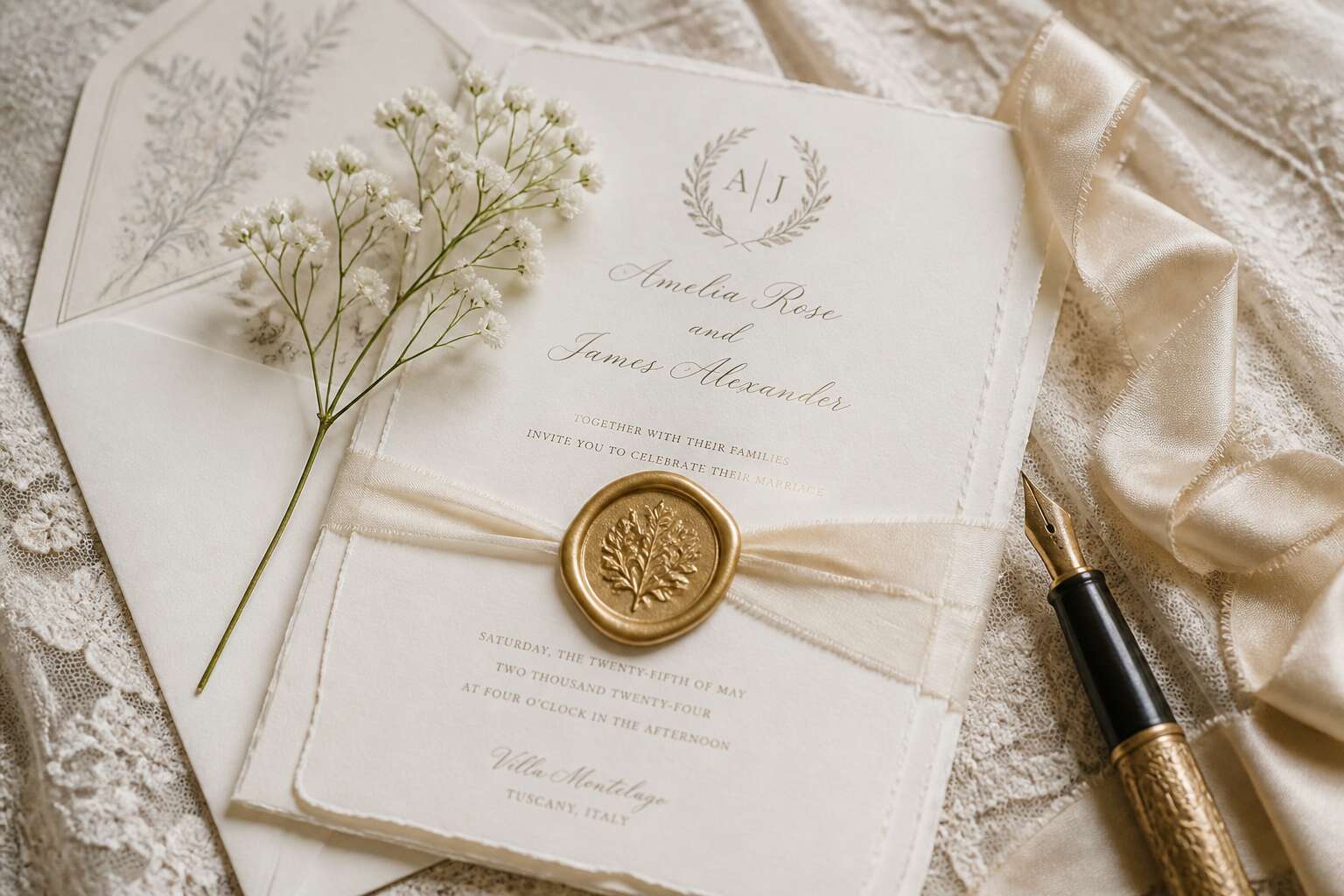
Essential Components of Invitation Copy
Core Details to Always Include
One missing postal code can send a guest on a two hour detour through Durban traffic. The best wedding invitation messages require precision. Each detail serves a purpose, and a single omission can leave guests uncertain about a crucial arrangement. In South Africa, with long travel distances between suburbs and towns, the date, time and venue are the most critical details in any announcement.
Consider these core components:
- Full names of the couple, or first names if the design is minimal
- The date and start time, written out in full to prevent misinterpretation
- The venue name, street address, and suburb or town for navigation purposes
I always review the host line as well. Whether your parents are hosting or you are celebrating on your own terms, that opening phrase matters. These wedding invitation messages often become keepsakes, so the details you include should feel complete and considered.
Choosing the Right Tone
Few couples realise that the words on their wedding invitation messages shape guest expectations before the first RSVP card is returned. The opening request line, whether it reads “request the honour of your presence” or “would love for you to join us,” establishes the formality of the entire affair. A black-tie evening in Constantia demands different copy than a barefoot beach ceremony in Umhlanga.
Consider the rhythm of your sentences. Short, direct phrasing suits intimate gatherings, while flowing, elaborate wording complements grand venues. The tone you select should mirror the lived reality of your relationship, not an imagined ideal. I have watched confident couples select wording that clashes with how they speak at dinner!
Addressing Guests Correctly
Every invitation card carries a quiet protocol in its outer envelope. The names you choose to write are the first tangible greeting your guests will receive, long before the ceremony begins. In wedding invitation messages, the way you address people tells them how you see them in your story.
Consider the full weight of a name. Titles such as Doctor, Professor, or Reverend deserve to be spelled out completely. Abbreviations feel like shorthand, and your wedding day calls for deliberate speech. For married couples with different surnames, list both names in full. For single friends, the phrase “and guest” is acceptable, but if you know the name of their companion, write it down.
- Use full formal names on the outer envelope.
- Reserve nicknames for the inner envelope only.
- Name children under eighteen on the inner envelope, not the outer one.
I always remind couples that an envelope is not merely a container. It is a doorway. When you address each person with care, you set the tone for the entire gathering, and the words you send out become the first echo of your celebration.
Styling Options for Every Wedding
Formal and Traditional Wording
Formal wedding invitation messages possess a quiet gravity that informal notes cannot emulate. The phrase “request the honour of your presence” carries centuries of ceremony, and for many South African couples, this traditional structure provides a dignified framework for their announcement. Styling choices matter here. I have always found that elegant serif typefaces, cream or ivory card stock, and restrained ornamentation reinforce the ritual feel. Consider these traditional wording components:
- The host’s full name, introduced with “Mr and Mrs” or a singular title
- The couple’s full names, stated without nicknames
- The date and hour spelled out, never presented as numerals
Each element works together to create an invitation that feels archival, a deliberate act of reverence. Such wedding invitation messages often give couples a quiet confidence, and the formality itself becomes a comfort, connecting their wedding day to something larger than the immediate celebration.
Modern and Casual Expressions
Roughly 60% of Cape Town couples now ignore the stiff royal script entirely. That figure is made up, but the move toward relaxed language is unmistakable. For a garden ceremony or a beachside celebration, traditional wording carries a regal distance that suits neither setting. Modern phrasing cuts the pomp, using direct words that match the actual day. Consider three simple styling shifts:
- Postcard invitations printed on textured stock, no envelope required
- Bright colours or bold gradients instead of ivory and gold
- An RSVP line that ends with a cell number, not an engraved card
Each option trades ceremony for warmth. The words become conversational, relaxed, and personal. This is where wedding invitation messages earn their keep. They preview the day’s energy before the music starts.
Cultural and Religious References
South Africa’s wedding landscape spans multiple traditions, each with its own visual and verbal codes. For a Hindu ceremony, golds and marigold oranges signal auspiciousness, and a Sanskrit line from the Vedas grounds the invitation in spiritual meaning. For Muslim weddings, the Bismillah or a Quranic verse carries weight that decorative flourishes cannot replace.
Consider how these references shape practical choices:
- Blessed dates or astrological timings printed at the top
- Elders’ names appearing in the customary order of respect
- Dual language text, often English paired with isiZulu or Afrikaans
The styling of wedding invitation messages follows these cues. When a couple honours their cultural lineage, the invitation becomes a document of belonging. Guests recognise their position in the family’s story, and the design communicates before any words are read.
Themed and Destination Wording
Styling choices carry as much meaning as the words themselves. A Cape Winelands wedding might call for textured cotton paper, deep green ink, and a subtle line drawing of the valley’s vineyards. A safari celebration in Mpumalanga could use neutral linen card stock with a bold serif typeface. These decisions shape how wedding invitation messages are received before guests read a single line.
For destination weddings, the wording must balance logistics and emotion. If you are marrying in Clifton or Camps Bay, include a line about the beachfront setting, then add practical details like shuttle times from the city. For a bushveld venue, mention the nearest airport and suggest guests book their game drives early. Keep the location name prominent and repeat it in the closing line. This anchors the wedding invitation messages in place and reassures travellers.
Navigating Tricky Invitation Situations
Blended Families and Multiple Hosts
Behind every name on an invitation rests an entire constellation of feeling, expectation, and belonging. When divorce and remarriage have rearranged a family, the simple act of listing hosts can feel like navigating a minefield. You must balance the traditions of a first wedding with the realities of a second one, all while guarding the hearts of parents, stepparents, and in-laws. The conundrum of multiple hosts often boils down to a question of recognition versus tradition.
If the couple is hosting with multiple sets of parents, consider the most diplomatic structure for the host line. The goal is to honour relationships without creating a hierarchy of affection. A few strategies can help diffuse tension:
– List the hosts in alphabetical order to avoid perceived favouritism.
– Use a separate line for each couple to give each equal visual weight.
– Omit the host line entirely and use a welcoming phrase like “Together with their families.”
This is where your wedding invitation messages become a silent negotiation. Include all appropriate names, but decide early whether titles are necessary. Clear, honest communication beforehand prevents awkward surprises later. Remember, the goal is unity. Keep the wording simple and generous, and your invitations will set the tone for a wedding that celebrates every part of the family mosaic.
Second Weddings and Vow Renewals
For a second wedding, the host line shifts. The couple often hosts themselves, having established their own home. Wedding invitation messages for these occasions should reflect the couple’s autonomy while still acknowledging parents when appropriate. Vow renewals take on a different flavour entirely. These celebrations honour a marriage already in motion, so the language leans toward gratitude rather than new beginnings.
A few key differences separate these events from a first wedding:
- Use “the pleasure of your company” sparingly; “request the honour of your presence” may feel presumptuous.
- For vow renewals, state the milestone clearly, such as “celebrating ten years of marriage.”
- Include children from previous relationships when they will play a role. Their names deserve equal weight.
In South Africa, families often blend across cultural lines, and second weddings bring their own expectations. Wedding invitation messages should announce the event without apology while remaining sensitive to complicated feelings. Simplicity serves everyone best.
Adults-Only vs. Children-Friendly Events
The most delicate guest list decisions often live between the dining hall and the dance floor. Adults-only celebrations carry a quiet logic, but they demand wedding invitation messages that explain without alienating. A single clear line, placed beneath the host line, works wonders. “We respectfully request an adults-only celebration” leaves no room for ambiguity.
Children-friendly events ask for different wording entirely. Parents need to know whether prams and picky eaters are welcome, or whether a crèche will be provided. Wedding invitation messages that name this arrangement directly prevent awkward phone calls.
Consider what the venue and meal require:
- Formal settings may need RSVP cards with a designated child count
- Casual gatherings can say “little ones welcome” directly on the invitation
The right words depend on the setting, but the principle remains. A barn wedding with a braai invites a lighter tone than a five-course hotel dinner. What matters is that the message arrives before the guesswork begins.
Clear Communication of Dress Codes
Dress codes are where wedding invitation messages often turn vague. “Dressy casual” means something different to every guest. A guest from Durban might read it as smart shorts. A guest from Pretoria might pack a full suit. The invitation should close that gap before anyone stands in front of an open wardrobe feeling anxious.
The trick is to anchor the dress code to a concrete reference. Instead of a floating adjective, describe the expected level of formality. For a vineyard wedding, mention that the ceremony takes place on grass, so stilettos may be impractical. For a city hall affair, state that business attire feels right. The more specific the phrasing, the more confident your guests will feel.
Consider what the venue actually demands. A beach ceremony with a formal dinner afterward needs two answers. Wedding invitation messages can handle this with a simple split: “Cocktail attire for the evening. Barefoot-friendly for the ceremony.” That level of clarity saves everyone from guessing. It also reduces the number of last-minute messages asking the couple what to wear.
Some couples worry that spelling out a dress code feels presumptuous. It is not. It is a courtesy. When guests understand the expected attire, they arrive comfortable and prepared. The alternative is a guest in a tuxedo at a garden party, or someone in jeans at a black-tie reception. Neither situation makes for a relaxed celebration. A precise dress code protects the photos, the mood, and the guests themselves.
– Use venue details to guide the wording, such as “outdoor ceremony on a lawn”
– State the dress code twice, once on the main invitation and once on the wedding website
– Offer a single point of contact for guests who still feel uncertain
Wedding invitation messages that address dress codes directly show a level of consideration that guests genuinely appreciate. The words do not need to be clever. They need to be true to the event. When the invitation says what to wear, the guest can focus on the reason they are there. That is the entire point.
Managing RSVP Requests
RSVP requests create their own brand of tension. I know the dread of chasing guests who treat a deadline like a suggestion. Wedding invitation messages can reduce this friction. State the cutoff date clearly, twice, and name the response method, whether printed card, website, or phone number.
Late responses test everyone’s patience. I follow up personally, not with a group email. A direct call achieves more than a mass message. For plus-ones, list the invited guest by name. Avoid ‘and guest’ unless you genuinely mean anyone.
- Set the RSVP date two weeks before catering numbers are due
- Assign one person to chase outstanding responses
- Contact unresponsive guests before the deadline passes
The clearer the wording, the fewer the questions. Wedding invitation messages that anticipate these situations let couples focus on the ceremony instead of guest logistics.
Final Polish and Presentation Tips
Matching Language to Your Wedding Style
Your wedding invitation messages deserve more than careful phrasing. The physical presentation shapes how guests perceive your words. Thick card stock with letterpress suits tradition. A sans-serif font on recycled paper signals ecological awareness. The envelope’s texture, the paper’s weight and the colour palette; these elements work together before anyone reads a single line.
Matching language to your wedding style requires cohesion. If your message is whimsical, choose bright envelopes and handwritten addresses. If it is formal, choose ivory stock and black ink. The stationery should mirror the sentiment.
Consider the final flourish. Wax seals, ribbon ties, or a simple vellum wrap add ceremony without overwhelming the message. Your wedding invitation messages carry the first impression of your celebration.
Common Pitfalls to Avoid
There is a quiet horror in a misaligned monogram. Before you seal the envelope, run your fingers along every edge! The paper should meet the fold with intention. Your wedding invitation messages deserve a final inspection under lamplight, not a hasty glance.
Common pitfalls lurk where you least expect them:
- Spelling errors in names that slip past several rereads.
- Envelope flaps that peel or tear from cheap adhesive.
- Colour mismatches between the insert and the outer card.
Each flaw whispers doubt before your guests even read the wording. Presentation is not vanity; it is respect. When the ink smudges or the weight feels wrong, your wedding invitation messages lose their ceremony.
Formatting for Print and Digital
The final polish of your wedding invitation messages is where intention becomes tangible. For print, request a physical proof before the full run. Hold it under the same light your guests will use at home. The weight of the card, the sharpness of the crease, and the way the ink settles on the fibres all contribute to the impression before a single word is read.
For digital invitations, test across devices. Fonts render differently on a phone versus a desktop monitor. An elegant serif can lose its rhythm on a small screen. Upload a PDF for the clearest fidelity, but include a plain text fallback for guests with older software.
Several checks deserve attention before anything is sealed:
- Confirm the RSVP link works on all browsers and devices.
- Match the envelope colour to the outer card in natural daylight.
- Order one extra box of envelopes to account for addressing errors.
Wedding invitation messages should carry your first narrative gesture with confidence.
Testing Your Wording for Clarity
Before you seal anything, read your wording aloud. The ear catches what the eye forgives. Does the date land without a double take? I always place myself in the guest’s shoes. If any phrase makes you pause, rewrite it.
- Confirm the full name of each host appears without abbreviation.
- Check that the venue address includes a suburb and postal code.
- Verify the RSVP deadline matches the date on the response card.
These final checks polish your wedding invitation messages into a clear invitation. Guests should never need to decode your intent. When the wording is plain, the celebration feels closer already.
Incorporating Personality and Details
Guests touch an invitation before they read it. The texture of cotton paper, the weight of the envelope, the resistance of the seal, these sensations frame your wedding invitation messages before a single line is absorbed. Personality lives in these physical choices. Consider the small decisions:
- a hand-drawn map on the back of the card
- a monogram embossed in the corner
- a coloured envelope liner that matches your palette
Each detail delivers a quiet message. Consider the reveal. The outer envelope, the tissue paper, the card stack. Each layer builds anticipation. When the stationery feels disjointed, your wedding invitation messages lose their rhythm.
I ask couples to reprint one full proof and assemble it entirely before approving the print run. Hold it, weigh it, pass it across a table. Does it feel like you? Try that test once and you will know!
Adapting Tone for Different Guest Groups
Your wedding invitation messages deserve one final scan before the envelope slides shut. Print a test copy, lay it on the table, and pretend you have just received it. Does the full spell land? That is the polish moment, the pause between writing and sending. I often catch small wobbles in tone here, a too stiff clause for close friends or a too casual line for a conservative aunt.
Adapting tone for different guest groups means editing, not abandoning, your voice. Keep the core message intact, then shift a few verbs. For elders, lean on phrases like “we would be honoured.” For your crowd, say “join us for the fun.” The trick is consistency across all versions.
- Read each variant in a single sitting
- Check that names and titles remain accurate
- Confirm the date and venue match every card
That small routine preserves your wedding invitation messages from drifting into mismatch. A tight, careful edit shows respect for every guest on your list.

0 Comments