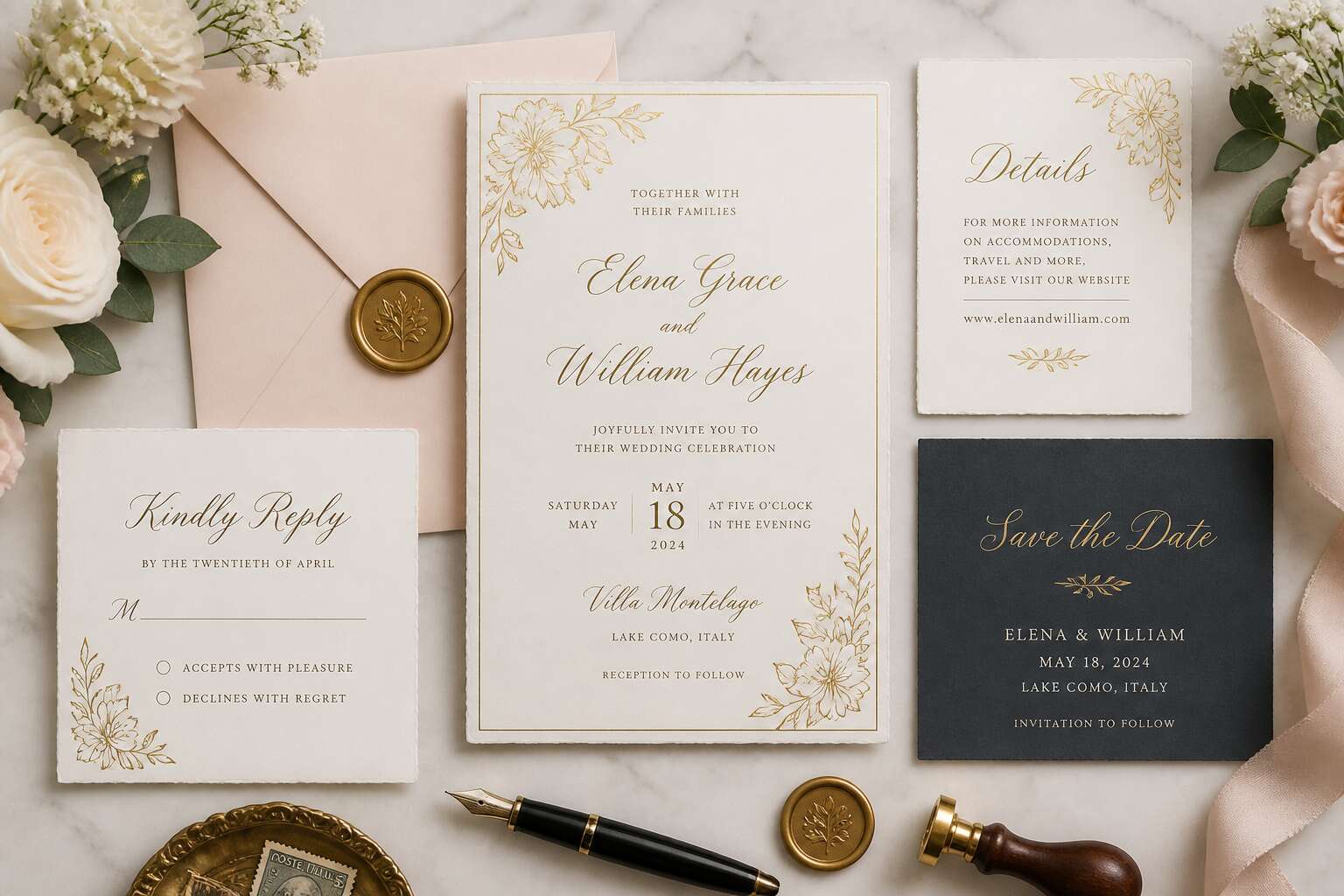
Essential Details to Include
The Host Line and Who is Inviting
The host line on your wedding invitation tells guests who is extending the invitation, and getting it right matters more than you might think. In South Africa, where family structures vary from traditional to blended, this single line can carry deep meaning. I have seen couples stumble here, unsure whether to list both parents, one parent, or themselves. The rule is simple: the host line names the people who are financially responsible for the wedding, even if that is a shared duty.
When you craft the content for wedding invitation, clarity beats formality every time. For a classic setup, the bride’s parents host. For modern couples, both sets of parents might share the honour, or the couple themselves take the lead. Here are common formats:
- Mr. and Mrs. Dlamini request the pleasure of your company
- Thandi and Sipho, together with their families, invite you
- Lerato and James, along with their parents, request your presence
The key is to avoid confusion. If you are the couple, write your own names without parental mention. If parents host, use their full names. This part of the content for wedding invitation sets the tone for the entire event, so take a moment to decide who truly stands behind the celebration.
The Formal Request Line
Clear Date and Time Handling
A single misplaced hour can disrupt an entire wedding day. In South Africa, where summer storms arrive without warning, precision in your invitation’s schedule becomes a form of hospitality. Guests need to know when to arrive and when the proceedings truly begin.
For effective content for wedding invitation, clarity starts with the date and time. Write the day of the week alongside the full date to avoid confusion. For the time, separate the ceremony start from the reception start, especially if a gap exists between them.
- State the year explicitly, particularly for weddings in January.
- Use the “12:00 for 12:30” format to distinguish arrival from seating.
- Note the venue’s indoor or outdoor setting, since South African summers shift quickly.
These details spare your guests from guesswork. They also reflect a deeper care, showing that every hour of their presence matters to you.
Matching the Wording Style to Your Event
Formal Language for Black-Tie Affairs
Black‑tie dictates a particular cadence. The language on your invitation must mirror the gravity of the evening. This is not about stuffing adjectives into every line. It is about precision and restraint. Formal wording uses full names, no abbreviations, and sentences that flow without haste. For a black‑tie affair, the content for wedding invitation should avoid playful phrasing. Instead, choose words that convey ceremony and respect. Consider the following:
- Use “request the honour of your presence” rather than casual alternatives.
- Spell out dates, times, and locations completely.
- Include a separate dress code card or line for clarity.
Each phrase creates a psychological contract with your guests. They read elegance in the structure, not just the words. When you match the style to the event, you prepare them for a night of deliberate celebration. Formal language is a promise. It tells guests that every detail, from the printed word to the final toast, has been considered with care.
Semi-Formal Wording for Modern Couples
For many modern couples, the traditional, fully formal invitation can feel a touch too rigid. It may not reflect the spirit of a relaxed weekend wedding or a laid-back celebration. This is where semi-formal wording becomes the perfect middle ground. It allows you to convey the necessary details with warmth and personality, while still maintaining a clear sense of occasion. The language is more approachable, yet it never sacrifices clarity or the fundamental respect you hold for your guests.
This style of content for wedding invitation gives you the freedom to share your story. You can move away from the passive voice and the third person. Instead of the formal “Mr. and Mrs. Smith request the honour of your presence,” you can directly invite your guests to share in your happiness. The tone is conversational, but it is still carefully considered. You are aiming for elegance without distance, and warmth without informality.
Consider the language you might use. You can start with a simple and heartfelt line such as “Together with their families” or “With joy in our hearts.” This sets a celebratory tone. You can be direct with your request, using phrases like “invite you to join them” or “request the pleasure of your company.” This maintains a polite formality but feels significantly more personal than the strict “request the honour.”
When addressing your guests, you have more flexibility. You can say “Please join us as we celebrate…” or “We would be delighted if you could join us.” This direct address creates an immediate connection with the reader. The content for wedding invitation becomes an expression of your personal style, a prelude to the event itself. It promises a celebration that is intimate, thoughtful, and uniquely yours.
To keep this elegant feel while letting your personality shine through, consider what details you include. Full names are still ideal for clarity, but you might skip the middle names. Dates and times should be written clearly, using words for the day and year, and numbers for the time (e.g., “Saturday, the tenth of October, at half past four o’clock” or simply “at 4:30 in the afternoon”). This is a place where you can blend tradition with modern simplicity. A list can help you decide on the structure:
– Opening Line: Use a warm, personal statement.
– Host Line: Decide if you are both hosting, or if families are involved.
– Date and Time: Be clear and elegant.
– Location: Include the venue with a brief description if desired.
– Dress Code: A simple “Semi-formal attire” or “Cocktail attire” is perfect.
– Further Information: This is a good place to mention your wedding website.
The goal is to craft an invitation that feels like a breath of fresh air. It moves away from the rigid script while still providing all the necessary information with grace. This balance is what makes semi-formal wording so appealing. It allows you to create a beautiful and meaningful piece that truly represents you as a couple. The words you choose set the stage for the entire celebration, ensuring your guests know exactly what to expect and are excited to be part of it.
Casual and Destination Style Phrases
Here is the article section you requested. It focuses on matching the tone to the specific event type, written in a clear and engaging style.
—
Weddings are as diverse as the couples who host them. A formal ballroom affair and a barefoot beach ceremony call for different words. The key is to match your phrasing to the actual atmosphere you plan to create. If you are planning a relaxed gathering, your content for wedding invitation wording should feel light and breezy. Avoid heavy, traditional phrases that might make guests worry about a stuffy dress code or a rigid schedule. Instead, think about how you speak to your friends. That authentic voice is often the best guide.
For an intimate garden party or a backyard barbecue, you can get playful. Use a line like, “We’re tying the knot and throwing a party!” to set an immediate, festive mood. You might want to drop the formal card stock entirely. A postcard with vibrant colors and casual fonts works perfectly for this style. The content for wedding invitation should be straightforward. Tell them where to go, when to be there, and that casual attire is welcome. You might even include a specific request, such as bringing a favorite dish to share. This wording makes it clear that the event is about genuine connection, not ceremony.
Destination weddings are a unique beast. They require a mix of excitement and crucial information. Your guests need to know about travel, accommodation, and the weather, so you can structure the information with a numbered list for clarity. This is one of the few times you can be a bit more direct and instructional. Consider this simple guide for your guests:
1. Give a firm date for booking travel.
2. Provide the exact resort or venue names.
3. Mention the dress code for evening events.
4. List local activities for early arrivals.
Even with all that necessary info, the tone should remain thrilling. You are not just announcing a wedding; you are inviting people on a trip. The phrasing should reflect that adventure. Use words like “join us in paradise” or “come celebrate with us in the city of lights.” This approach to the content for wedding invitation wording elevates it from a simple notice to an exciting preview of the event.
Ultimately, the best phrasing feels like a handshake or a hug. It connects you to your guests before they even RSVP. By considering the physical location and the level of formality, you can craft the perfect message. This ensures your guests know exactly what to expect and feel genuinely excited to be part of your special day. Keep it simple, keep it honest, and let your unique personality shine through.
Themed or Religious Invitation Text
Six in ten couples incorporate a personal or cultural tradition into their wedding ceremony. For religious weddings in South Africa, the wording often mirrors the liturgy of the ceremony itself. A traditional Nguni or Anglicized approach might require verses from scripture. The content for wedding invitation should reflect this spiritual dimension without becoming a sermon.
For themed events, historical periods like the roaring twenties or a local shweshwe chic occasion need consistent language. A cohesive voice carries the theme forward.
Consider the logistics:
- Does the religious practice require a specific dress code for entry?
- Are there restrictions on photography in the places of worship?
- What are the customary greetings or protocols?
Practical clarification within the invitation helps guests participate respectfully. It shows you value their role in the spiritual milestone. Each choice creates content for wedding invitation wording that resonates with a sense of place and purpose.
Structuring Information for Guest Clarity
Formatting the Venue and Address
Some would argue, with some justification, that the true art of invitation phrasing lies not in what you write, but in how you organize it. We labor for weeks over the perfect verb, yet a single line of confusion regarding the location can unravel the entire affair. The physical address, the very coordinates of your love story, deserve more than a haphazard line. This is about navigation, but it is also about anticipation. The visual rhythm of the page guides the eye, and therefore the mind, toward the destination.
The separation of elements is a subtle art. The venue’s name is a statement, but the street address is a necessity. When a couple withholds the latter, or buries it, they invite a flood of anxious calls. You must think of the reply card as more than a formality; it’s a commitment. However, the commitment begins with the journey. If you are asking guests to travel, especially from different provinces, the way you present this information provides clarity.
Here is the trick of the trade that I have found invaluable during my years: The venue name is an introduction, but the address is the contract. The postcode remains the final, unspoken promise of your hospitality. It is often wise to separate the aspects of the location to prevent cognitive overload:
– The primary venue name on its own line.
– The physical street address and suburb directly beneath.
– The town or city, followed by the postcode.
This structure allows the eye to parse the information incrementally. It prevents the guest from having to decipher a paragraph of text. I have also found that clarifying whether the venue is the same for the ceremony and reception can eliminate the most confusion. You must feel the flaneur energy in the way you guide them. You must state, explicitly, if transport is required. The content for wedding invitation design can be efficient; the content for wedding invitation logistics must be reticular, creating a network of clear paths.
The devil, as they say, is in the details. But so is the divine. When you place the full date in a prominent position, but then fail to mention the time of day clearly, you have created an unnecessary hurdle. It is an act of consideration to assume your guests are intelligent, but it is an act of love to assume they are also distracted, tired, and possibly running late. Therefore, we format for the benefit of their future, calmer selves.
The single most impactful sentence in your package might not be the promise of a “union” at all. It could be the line that reads, “Reception to follow at the same venue.” We sometimes overthink the psychology of our guests. They do not need to know the theme of our first date or the significance of the flower arrangements, they just need to know if the drive includes a dirt road and whether to bring a jacket. Ultimately, the specific address is a form of generosity. Give them the map, and they will find their way back to you, ready to celebrate.
Specifying the Dress Code
The tyranny of the dress code is a silent killer of many a good party. A guest will forgive a lukewarm canapé, but they will not easily forgive the shame of arriving in a floral sundress when the room is a sea of stiff black suits. The line you write for attire is not a suggestion; it is a contract between your vision and their wardrobe. When you place it on the invitation, consider what it truly asks of them. A trip from Cape Town to a vineyard in Franschhoek requires specific gear, and the content for wedding invitation should acknowledge the realities of the journey, not just the aesthetic.
It is wise to avoid the single word “Smart” or the ambiguous “Semi-Formal”, as these terms are interpreted with wild regional variance. What is standard in Pretoria might be scandalous in a coastal garden. Providing a brief descriptor of the expected level of formality is often more helpful than a strict list of banned items. However, when you wish to be explicit, consider the clarity of a direct list.
– Specify the full dress code name, such as “Black Tie Optional” or “Garden Party Chic.”
– Add a single clarifying line for the men, like “Jacket required.”
– Give the women a hint of length, such as “Knee length or longer.”
That level of detail prevents the frantic WhatsApp messages that plague the days before the event. It is far better to be perceived as slightly prescriptive than to leave your guests fumbling through their closets in a state of anxiety. The goal is to let them know that you have thought about their comfort, and their confidence, as a direct result of the guidance you provided. The effective use of specific language here reduces friction and increases the joy of preparation. Just remember to include this crucial information prominently, and watch the collective sigh of relief from your guest list.
Setting an RSVP Deadline
A clear invitation is a gift to your guests, and the RSVP deadline is its most crucial clause. This date isn’t a gentle suggestion; it is the anchor for your caterer, your venue, and the entire logistical ballet behind your day. Without a firm date, you are left chasing guests while finalising seating charts, a stressful scenario no couple needs.
When you build your content for wedding invitation, give these details a dedicated space. A small, clearly labelled card or a distinct section on your main suite works perfectly. Providing the date and a method for response ensures smooth sailing. Consider these points when structuring that part of your correspondence:
- State the deadline prominently, ideally four to six weeks before the wedding.
- Include a specific response date, not just a month.
- Clarify whether you prefer a physical RSVP card or a digital response through your wedding website.
With the rise of online tools, many couples now direct guests to their website for replies. This simplifies tracking and reduces postage, but the principle remains unchanged: the deadline must be crystal clear. If you are planning a destination affair in the Winelands, a quicker turnaround might be needed for travel arrangements. Ultimately, the most effective content for wedding invitation prevents confusion, ensuring you receive the answers you need to celebrate without worry. Just remember to write the deadline on the invitation itself; it is the key to a calm planning season.
Incorporating Accommodation Options
Guests arrive with three pressing questions: what time, what to wear, and where to rest their heads. Clear structuring of your content for wedding invitation solves those queries before they surface. Grouping logistical details into distinct blocks transforms a jumbled suite into a serene guide. Do not bury theahotel list in the small print.
Accommodation options demand special attention in South Africa’s remote venues. If your celebration takes place in the Cape Winelands or the Garden Route, list lodging guidance on a separate card or website page:
- Nearby guest houses and hotel names with distances from the venue
- Preferred rates or block booking codes
- Transport arrangements for the reception’s close
This transparency spares you a hundred queries. Provide a phone number for the accommodation coordinator. The finer the information, the smoother the guest experience. Your content for wedding invitation becomes a practical tool rather than a decorative afterthought.
Adding Online Wedding Registry Links
Guests will forgive a late bar, but never a disorganised website. The content for wedding invitation should direct guests with precision. Group every detail under clear headings. Each logistical block stands alone, and I promise this saves you from a hundred private messages.
For online registries, place the URL on the wedding site home page. Add a second link on the confirmation page after guests submit their response. Keep the wording neutral:
- Gifts are optional, but appreciated
- Cash funds for honeymoon adventures
- Charitable donations in lieu of presents
This structure keeps everything crisp and mercifully simple!
Navigating Etiquette and Special Cases
Blended Family Names and Divorced Parents
When a family has navigated divorce or remarriage, the phrasing on the invitation can feel like a high-wire act. The emotional weight of a name is immense, and the wording must balance historical loyalty with present-day dynamics. It is common to overthink this step, but clarity and respect will always guide you. Try to view the wording as a structural map of relationships, not a value judgment on them.
For the mother of the bride, her new surname changes the entire logistics of the hosting line. If she has remarried but the parents are co-hosting, you must decide on the order of names. A single header like “Together with their families” can alleviate the pressure of listing every last name twice. This allows the parents to be named on separate, subsequent lines without a cumbersome grammatical tangle.
When divorced parents are involved, consider the etiquette of who gets top billing. The parent who hosted the engagement party or who resides in the home hosting the wedding often takes precedence, but this is not a hard rule. If you choose to list both, a simple semicolon between their names avoids the implication of an active marriage. Avoid the phrase “and,” which legally and romantically couples them.
For blended families with step-parents, ensure the biological parent and step-parent are both recognized without erasing anyone. The line “Jane Smith and John Doe, along with Mark Brown, parents of the bride” clarifies biological roles while celebrating the step-parent’s presence. However, this can get wordy, so you might simplify the hierarchy.
– The bride passes: Michael Johnson and Sarah Miller, parents of Emily Johnson
– The groom passes: David Thompson and Rachel Adams, parents of James Thompson
– Alternative: Use a single collective line if multiple surnames create a bulky paragraph.
Ultimately, the content for wedding invitation must serve the couple’s truth. If you are unsure, phone the parents separately and ask how they wish to be identified. Their comfort is the ultimate metric of success here. A clean, respectful list is far more elegant than a forced, grammatically perfect sentence that leaves feelings bruised.
Wording for a Second Marriage
Navigating Etiquette and Special Cases in Wedding Invitation Wording
Second marriages bring their own set of considerations when crafting the perfect content for wedding invitation wording. The joy of一个新的 beginning mingles with established family structures, creating opportunities for both celebration and sensitivity. Couples entering a second marriage often wonder how to honor children from previous relationships, ex-spouses, and new extended family members without creating confusion or hurt feelings.
Wording for Remarriages and Blended Families
Content for wedding invitation wording in remarriage situations requires a delicate balance between acknowledging the past and embracing the future. Many couples choose to omit the word “bride” and “groom” altogether, opting instead for terms like “partners in life” or simply their names. This approach removes any implied hierarchy and focuses on the union itself rather than traditional labels.
For couples with children, including them on the invitation signals their importance in the new family unit. Some families choose to list children’s names alongside the couple’s names, while others prefer a separate line that reads “together with their children.” The choice depends on the children’s ages and the couple’s personal preferences.
Host Line Considerations
When parents are hosting the wedding, content for wedding invitation wording typically includes their names. However, remarried parents present unique challenges. Here are some common scenarios:
– Both biological parents hosting together, despite being divorced
– A parent and stepparent hosting as a couple
– Parents hosting with the couple themselves
– The couple hosting independently
For divorced parents co-hosting, etiquette suggests listing the mother’s name first if she has primary custody, followed by the father’s name on a separate line. Using “and” between their names implies they are a couple, which is why wedding invitation wording experts recommend using separate lines whenever possible.
Blended Family Wording Examples
When both sets of parents are hosting, you might see content for wedding invitation wording like this:
Sarah Elizabeth Thompson and James Michael Anderson request the honour of your presence at their wedding together with their parents Mr. John Thompson and Ms. Linda Reynolds and Mr. David Anderson and Mrs. Karen Anderson.
Notice how stepparents may be included or excluded based on the couple’s relationship with them. Some couples choose to include stepparents as a sign of respect and family unity. Others exclude them to avoid complications or because the relationship is distant.
Perfect Wording for Second Marriages
Content for wedding invitation wording for second marriages often eliminates some formal elements. The phrase “request the honour of your presence” might become “together with their families, request the pleasure of your company.” This softer language reflects the more relaxed nature of many second weddings.
For couples hosting their own wedding, the wording becomes direct and personal: “Together with their children, Sarah and James invite you to share in their joy as they exchange vows.” This approach places emphasis on the couple’s agency and the family they are building together.
Addressing Specific Situations
1. When a parent has passed away and a stepparent is helping host, their name might appear as “Mrs. Jane Anderson and her late husband’s family” or simply with the stepparent listed alone if the relationship supports it.
2. When children are part of the ceremony but not listed on the main invitation, a separate reception card might include their names as a loving gesture.
3. When the couple has been living together publicly, content for wedding invitation wording might skip some traditional elements, moving directly to the invitation itself without extended host lines.
4. When the couple’s surnames are hyphenated or they have kept their own names, the invitation should respect these choices without comment or explanation.
The most important element in content for wedding invitation wording for second marriages remains clarity. Guests should understand who is hosting, who is getting married, and where the ceremony will take place. Beyond these basics, the invitation becomes a statement about the couple’s values and their vision for their new family.
Modern etiquette emphasizes kindness over rigid rules. When in doubt, couples should choose wording that reflects their genuine relationships. An invitation that feels authentic to the couple will always create the right impression, regardless of whether it follows traditional formats. The goal is not perfection but connection, and content for wedding invitation wording should always serve that deeper purpose.
Including Children in the Ceremony
Politely Excluding Children
Nearly three in ten couples now opt for an adults-only affair, per recent industry data. Yet the thorniest hurdle remains how to phrase this preference without causing familial friction. When drafting content for wedding invitation, the wording must exude warmth while maintaining clarity.
Consider the psychological nuance: guests with children need to understand the decision stems from logistical or atmospheric desires, not dislike. We find a courteous approach involves stating the rule directly on the response card, not just the main invite. To aid your decision, consider these three tactful phrases!
- “While we adore your little ones, this celebration is for adults only.”
- “Please join us for an intimate evening; we kindly request no children.”
- “Our venue has limited capacity, so we respectfully host an adults-only gathering.”
Ultimately, transparency paired with a gentle tone transforms potential awkwardness into a graceful boundary. When finalizing content for wedding invitation, remember to honor your vision while preserving relationships, so offer babysitter recommendations or a separate farewell brunch if possible!
Handling the Gift and Registry Language
Nearly three quarters of South African couples now list a cash gift option on their wedding website, according to recent local industry surveys. This shift reflects a practical reality. Young couples often already share a home, so traditional chinaware and toaster ovens pile up unused.
Your content for wedding invitation should steer guests toward your registry with tact and clarity. The old taboo around mentioning gifts has faded, but heavy-handed demands remain unacceptable. Frame the registry as a convenience, not a requirement, and place it on a separate enclosure card alongside accommodation details.
Consider these presentation methods:
– A printed card with the registry website and a warm explanatory line
– A subtle line on the response card with a link to your wedding webpage
– No mention in the printed suite, relying solely on your online platform
A phrase such as “Your presence is the greatest gift, but for those who wish to contribute, a small registry exists online” works well. This communicates without pressure)Skip the guilt trip. Couples in Johannesburg and Cape Town increasingly favour the direct approach: “We have registered at X, but your company is all we truly need.”
The wording must feel like a natural extension of your invitation’s voice. A formal affair demands restrained language. A beach ceremony allows a breezier tone. Match the registry note to the overall style of your content for wedding invitation.
When guests ask where you are registered, respond with enthusiasm and simplicity. The goal is easing their path to generosity, not creating a transaction. Done well, this section reads as a helpful pointer rather than a demand. Done poorly, it colours the entire invitation with mercenary undertones.
Digital registries now offer honeymoon funds, home deposits, and charity options. Mention one central hub instead of multiple sources. This reduces confusion for elderly relatives and tech-shy guests. Clarity serves everyone.
Digital Invitations and QR Code Text
Navigating the etiquette of wedding gifting in South Africa has changed, but one classic line still needs a gentle tap on the brakes. The phrase “Your presence is the present” often creates awkwardness for guests who genuinely want to give something tangible. Modern couples find that honest phrasing works best. For example, you can say “We have everything we need for our home” without sounding dismissive. This approach acknowledges the guest’s generosity while steering them toward your registry. It keeps the tone warm, not transactional.
When you write the content for wedding invitation digital elements, the wording matters just as much as the design. The QR code that links to your registry should sit discreetly on the details card, not on the main invitation. Pair it with a simple line like “Find our gift list here” rather than a lengthy explanation. This keeps the focus on the celebration itself. Your guests will appreciate the clarity, and you will avoid the cringe of a demand disguised as a request.
Quick Checks Before You Send
Proofreading for Typos and Grammar
A single typo can unravel the elegance of a carefully crafted invitation. It is the silent flaw that guests notice, even if they do not mention it. Before you click send or drop the envelopes in the post, you owe your event a final, meticulous review. Print a physical copy if you can; errors often hide on a screen.
Run your eyes over every line with fresh intent, and consider these specific points:
– Read the names aloud to catch awkward phonetic pairings.
– Verify the date and time against a calendar for the correct day of the week.
– Check that the spelling of the venue is exact, as auto-correct often intervenes.
– Confirm that your contact details for RSVPs are error-free.
This final pass is about respect for your guests and for the ceremony itself. It distinguishes a thoughtful invitation from a careless one)Skip the markdown. The very act of proofreading sharpens the focus of the entire content for wedding invitation quality, ensuring your message is received exactly as you intended it to be. It is the last, quiet conversation you have with your stationery before it goes out into the world, speaking on your behalf.
Avoiding Overly Wordy Sentences
The average guest spends less than two minutes reading a wedding invitation. That is not a lot of time to convey your joy, your style, and the essential details of your big day. When you start drafting the content for wedding invitation wording, it is tempting to fill the space with flowery language and lengthy explanations. Resist that urge. A cluttered card confuses your guests and dilutes the emotional impact of the announcement.
Think of your invitation as a streamlined message, not a novel. The goal is to deliver crucial information with grace and clarity. In my experience, the most elegant invitations are often the most direct ones. If you find yourself using three sentences where one would suffice, you are likely overcomplicating the text. For example, instead of writing “We would be delighted to have the pleasure of your company to celebrate with us,” simply use “Join us for our wedding.” The sentiment remains, but the impact is stronger.
To ensure your phrasing remains crisp, focus on these quick checks before you send the file to the printer.
- Read the text out loud. Does it sound like how you actually speak? If it feels stiff, rewrite it.
- Look for “dead words.” Words like “happy,” “very,” and “simply” often add no value. Remove them and see if the sentence stands stronger.
- Verify the timeline. Does the address on the card match the one on the envelope? Is the date format consistent?
This editing phase is not about stripping your personality away. It is about ensuring your guests actually read the vital details. A long paragraph about the couple’s journey is lovely, but if it buries the reception start time, you have failed in the primary goal of the card. The primary function of the content for wedding invitation pieces is to inform and delight, in that order.
I have seen invitations that try to do too much, explaining parking logistics, dress code nuances, and meal selection notes all in one massive block of text. It is overwhelming. Instead, embrace the power of white space. Let the design breathe. If you need to convey a large amount of logistical data, consider a separate details card or a wedding website. This keeps the main invitation elegant while ensuring the crucial information is still accessible.
As you refine the language, ask yourself if the invitation reflects the tone of the event. A formal ballroom affair demands a certain level of polished prose, while a casual farmhouse celebration allows for a more relaxed approach. Match the words to the occasion to set the correct expectation for your guests. Ultimately, the most effective content for wedding invitation wording is the text that feels true to you as a couple. If the message sounds like a bureaucratic memo, start over. If it sounds like a warm, excited conversation you would have with your loved ones, you are likely on the right track. Keep it concise, keep it warm, and keep it clear. Your guests will appreciate the clarity, and you will appreciate the peace of mind.
Verifying All Names and Spellings
A single letter wrong in a guest’s name turns your content for wedding invitation into an awkward conversation starter. I have seen “Sarah” become “Sara” and “Kruger” lose its umlaut. The problem is that you read what you expect to see, not what is printed. So verify every entry against your contact list, not your memory.
Check the wedding party names too. The best man might go by a nickname, but the invitation should use his full legal name. For family members, confirm the exact spelling of each surname. This includes parents and stepparents.
- Compare the guest list to the envelope labels.
- Ask a friend to read the names aloud!
- Verify titles like Dr. or Mr. before sending.
Your content for wedding invitation depends on these details. A clean name list shows respect and prevents embarrassment.

0 Comments