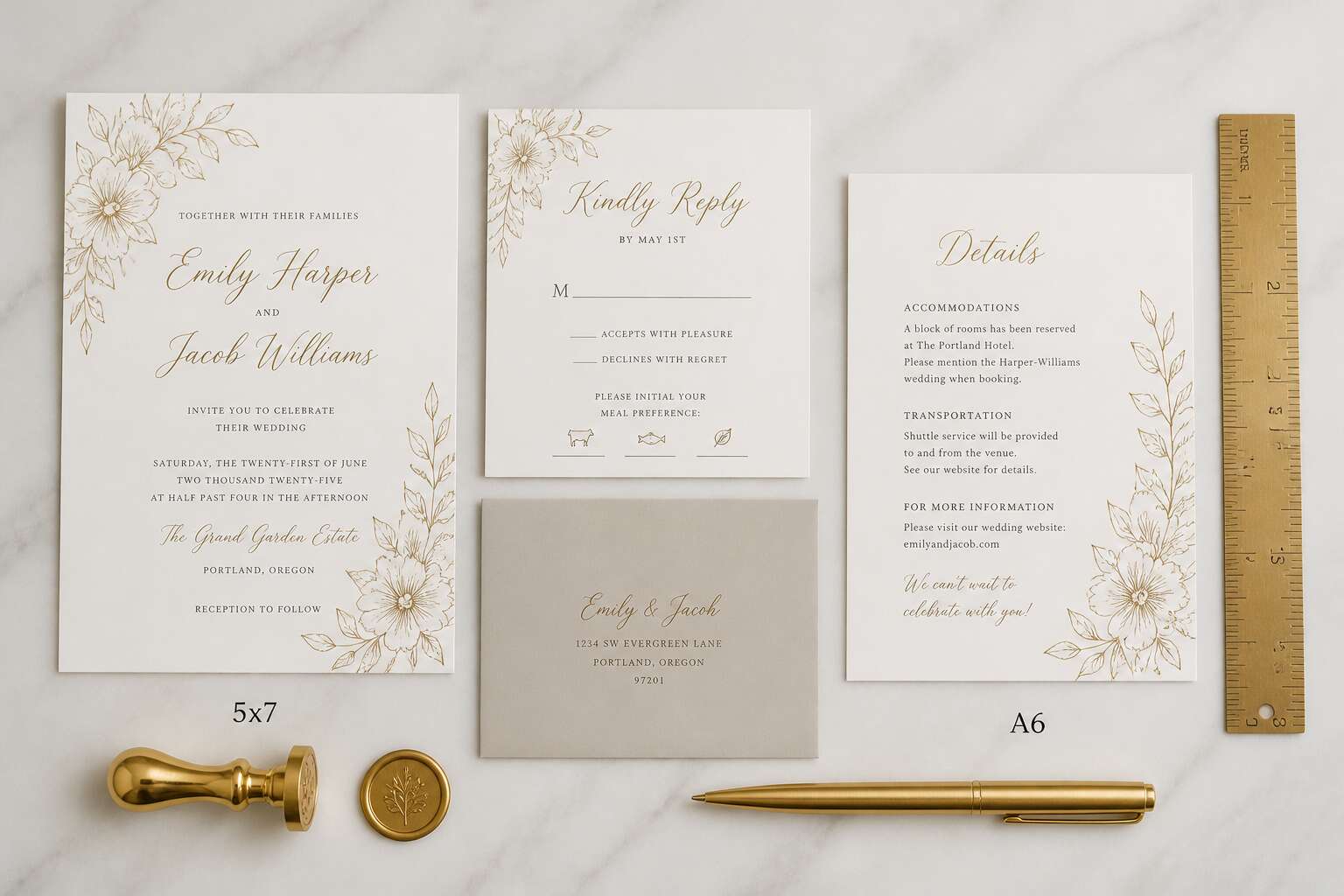
Understanding Wedding Invitation Size Basics
Common Size Categories
The enquiry into what is wedding invitation card size has a practical answer, but it arrives with caveats. The classic 5×7 inch standard remains the most common, though South African stationery shops routinely stock A6 and A5 alternatives. A6 measures 105 by 148 millimetres, perfect for a modest note. A5 doubles that canvas, giving your words room to breathe! Then you have square formats, which suggest modern chic until you calculate the extra postage.
Common size categories:
– 5×7 inches
– A6 (105 x 148 mm)
– A5 (148 x 210 mm)
– 5×5 or 6×6 inches
The size you choose dictates how the card sits in a palm and how it commands attention. A larger card feels like a proclamation, while a smaller one implies quiet intimacy. So when someone asks what is wedding invitation card size, the honest answer is that it depends on the impression you wish to manufacture.
Why Size Matters
Size dictates the first impression before a single word is read. When someone asks what is wedding invitation card size, they are really asking how their event should feel. A card that fits snugly in the palm creates an intimate exchange, while a larger sheet demands ceremony. The physical weight and dimensions affect how guests handle the invite, how it rests on a mantel, and how much postage you pay.
Consider the practical chain of consequences:
- The envelope must match the card exactly.
- The postal service in South Africa imposes surcharges for non-standard dimensions.
- The pocket folder or belly band must be cut to fit.
Each measurement affects the next. Getting the size right means your invitation arrives intact and impresses before the envelope is even opened. That is the true answer to what is wedding invitation card size.
Industry Standard Dimensions
South Africa’s Post Office sorts mail by size before it reads a single address. An A6 envelope at 105 by 148 millimetres glides through automated machinery. Anything larger gets pulled aside for manual handling. That extra step costs you money.
What is wedding invitation card size in practical terms? It is the measurement that keeps postage affordable and your timeline intact. The A-series grid is the industry standard. These are the dimensions your stationer knows by heart:
- A6 (105 x 148mm) for single-card invites
- A5 (148 x 210mm) for two-piece sets
- A4 folded once for a ceremonial reveal
Custom sizes require custom dies, setup fees, and slower production. Standard dimensions pair with ready-made envelopes that seal cleanly and move through the mail stream without interruption. Choosing A5 or A6 means choosing reliability.
Metric vs Imperial Measurements
The question of what is wedding invitation card size becomes tangled when you cross measurement systems. South Africa runs on metric. Your stationer measures in millimetres. But most inspiration photos from America quote everything in inches. I have seen couples fall for a 5 by 7 inch invitation, only to learn it converts to 127 by 178 millimetres. That dimension does not exist in the A-series grid. It needs a custom die and envelope. The cost difference is immediate!
Consider the mismatch:
- A US 5×7 inch card is slightly wider than A6
- A US A7 envelope is not stocked by South African suppliers
- Imported envelopes take weeks to arrive
The metric system is not a preference here. It is the infrastructure. When you ask what is wedding invitation card size, the honest answer is that your local printer works in millimetres. Insisting on imperial means paying for the exception.
Standard Sizes for Different Invitation Styles
Traditional Flat Cards
Traditional flat cards remain a popular choice for wedding stationery. These single panel invitations typically measure 148mm by 210mm, which is the A5 format, or the more compact 105mm by 148mm A6 size. South African couples often favour A5 for its generous space, allowing the design to breathe without feeling sparse.
Consider this practical breakdown when selecting your flat card:
- A6 flat cards work well for intimate gatherings with minimal text.
- A5 flat cards accommodate longer poems, maps, or bilingual wording.
- Square flat cards, at 140mm by 140mm, offer a contemporary alternative.
The answer to what is wedding invitation card size depends on your content volume. A heavier card stock may demand a slightly larger dimension to prevent curling. The flat card’s simplicity means the size carries the entire aesthetic impression.
Folded Invitations
Folded invitations complicate the answer to what is wedding invitation card size because a folded card has two dimensions: the compact form that slips into the envelope and the full spread when opened. My standard advice is to start with the folded size, not the unfolded sheet. An A4 sheet folded once yields a 148mm by 210mm card, the A5 format. That gives you four panels for your text and imagery.
For smaller weddings, an A5 sheet folded in half produces a 105mm by 148mm card, the A6 format. The result is compact and intimate. The fold itself adds thickness, so your envelope must be slightly deeper than a flat card of the same size.
Bi-fold and gatefold styles each change the final measurements. A gatefold opens outward in three panels, while a bi-fold mirrors a greeting card. Test the blank stock before committing to a print run. The physical bend alters how the card sits and how much weight it can hold.
Pocket Invitations
Pocket invitations add a protective sleeve around your main card, which changes what is wedding invitation card size in a practical way. The outer pocket is the largest element. It needs to be big enough to hold the inner card plus any loose inserts, such as response cards or directions.
A typical pocket measures 5 by 7 inches, while the inner card sits at 4.25 by 5.5 inches. Some designers use A5 for the pocket and A6 for the main card. The assembled stack is noticeably thicker than a single flat card.
- Pocket 5 by 7 inches, main card 4.25 by 5.5 inches
- Pocket A5, main card A6
- Pocket 130 by 180 millimetres, main card 120 by 170 millimetres
When I consult with couples in South Africa, I ask them to bring the finished pocket invitation to their envelope order. The pocket flap and corner folds add a few millimetres to the final footprint. If you are still asking what is wedding invitation card size for this style, the answer is the assembled package, not the individual cards.
Unique Shapes and Die-Cut
When couples ask what is wedding invitation card size for a unique shape, I always warn them about the bounding box. A circular card, for instance, does not behave like a rectangle. The envelope must accommodate the widest point, which means a 5 inch diameter circle needs a 5 by 5 inch square envelope at minimum, and often a slightly larger one for wriggle room!
Some shapes I have encountered in South African stationery orders:
- Circular cards at 5 inches in diameter, or 127 millimetres.
- Hexagonal cards with a 4.5 by 5.5 inch bounding rectangle.
- Die-cut arches that require a 5 by 7 inch envelope despite a smaller visible card.
Die-cut details, such as laser-cut lace or scalloped edges, add tactile charm but alter the physical footprint. A flat card that begins as a standard size can grow once the die-cut pattern pushes the outer boundaries. The real answer to what is wedding invitation card size for these styles is the envelope you must actually order, not the card you admire.
Minimalist and Modern
Minimalist and modern invitations often look effortless, but size still matters. A single flat card in A6 or 5 by 7 inches covers most contemporary requests. Square cards at 5 by 5 inches also appear often, especially for couples who want a bold, clean line.
What is wedding invitation card size for these styles? Usually the envelope dictates the answer. Modern folded cards might use a 4 by 6 inch final size, but a minimalist design with thick paper or a belly band needs extra millimetres. My rule: measure the whole package, not just the card. That prevents post office tears.
Common choices include:
- A6 (4.1 by 5.8 inches)
- 5 by 7 inches flat
- Square 5.5 by 5.5 inches
How to Choose the Right Size for Your Wedding
Matching Size to Theme
The right invitation size does more than fit an envelope. It sets the tone for your entire wedding. A relaxed beach ceremony calls for a compact card that feels effortless. A black tie affair demands a larger folded format with more gravitas.
When you ask what is wedding invitation card size, think about how your theme translates to paper. A whimsical garden party suits a square card. A formal dinner wants something longer and more structured. Proportion matters more than following a trend.
- Rustic or outdoor themes work well with 5×7 inch cards on textured stock.
- Classic or traditional events favor 4.25×5.5 inches, clean and simple.
- Modern or artistic celebrations can handle oversized or uniquely shaped options.
A bulky invitation inside a small envelope feels cramped. A tiny card in a large envelope looks lost. Match the physical weight of your invitation to the formality of your occasion, and you will never miss the mark.
Budget and Mailing Considerations
Mailing costs in South Africa can change your decision faster than aesthetic preference. The South African Post Office charges by weight and dimension. A standard 5×7 inch card with a textured envelope weighs around 25 grams. A pocket invitation can push past 50 grams. That shift doubles your postage per guest.
Budget works the same way. Larger cards require more paper, more printing, and heavier envelopes. The price climbs with each millimetre. For 120 guests, a R5 difference per invitation becomes R600. I always tell clients to weigh the full package before ordering. Consider these extras:
- Wax seals add thickness and require hand sorting.
- Die-cut shapes often need custom envelopes.
- Ribbon ties make the card lumpy, which can trigger surcharges.
So when you ask what is wedding invitation card size, remember that size determines postage and paper costs. Weigh your invitation with its envelope first. That single step prevents surprise costs at the counter.
Envelope Size Compatibility
The envelope is the uncompromising border of your invitation. A card must physically fit within that paper boundary. I once watched a 100x100mm square invitation crumple because the envelope lacked a millimetre of interior girth. The dimensions printed on a pack can mislead you.
The gauge of your cardstock, measured in grams per square meter, changes everything. A 250gsm flat card may slip inside a standard C5 with ease, but a 350gsm card adds thickness that demands a deeper mailer. Look for the words ‘deep’ or ‘expanding’ on the envelope label.
- Measure the card’s actual thickness, not its length and width.
- Check the diagonal clearance when the envelope flap is closed.
- Test for play: the card should shift, not bend, when inside.
So when you ask what is wedding invitation card size, the answer is locked in an envelope’s interior. Choose them together, or the entire effect fades.
Envelope Sizes and Their Relationship to Invitation Sizes
Standard Envelope Dimensions
In South Africa, the envelope dictates the invitation. The DL envelope, 110 by 220 millimetres, is the standard choice for local stationery. It holds a flat A4 card folded twice, or a smaller card with room to spare. If you are asking what is wedding invitation card size, start with the envelope. The card must slip inside without buckling. Add 3 to 5 millimetres for clearance. That gap accounts for paper thickness and the natural give of the fold.
Standard envelope dimensions follow the international A-series. The common pairings are straightforward:
- C6 (114 by 162 mm): holds an A5 card folded once
- C5 (162 by 229 mm): holds an A5 card flat
- C4 (229 by 324 mm): holds an A4 card flat
These dimensions directly answer what is wedding invitation card size in practical terms. Designers settle on the envelope first, then build the card within those limits.
A-Series Sizes
The A-series works on a simple principle. An A4 sheet measures 210 by 297 millimetres. Fold it in half and you get A5. Fold again and you get A6. The proportions stay identical each time. That consistency matters when you ask what is wedding invitation card size, because every A-series card has a natural envelope counterpart.
South African printers stock these sizes as standard. They cut, score and fold thousands of invitations on A-series machinery. Designing within these dimensions avoids custom cutting fees and delays.
The standard bases look like this:
- A4: 210 by 297 millimetres, the largest common invitation panel
- A5: 148 by 210 millimetres, a comfortable single panel
- A6: 105 by 148 millimetres, suited to compact reply cards
C-series envelopes are purpose built to hold these cards, with a few millimetres of clearance included. That system has served stationers since the 1920s, and it still answers what is wedding invitation card size for most local printers.
Inserting and Layering
The envelope does more than carry the card. It creates the first moment of tension. When you ask what is wedding invitation card size, you are really asking how the card will sit inside its envelope. A card that fits poorly ruins the reveal. A card that fits perfectly feels inevitable.
Layering complicates the fit. A single A6 card slides into a C6 envelope with room to spare. Add a reply card, a map, and a details card, and the stack grows. The envelope must be deep enough to hold the layers without bulging. The relationship between card size and envelope size involves width, height, and thickness.
Consider the common combinations:
1. A6 card with one reply card in a C6 envelope
2. A5 folded card with two inserts in a C5 envelope
3. A4 panel with a belly band in a C4 envelope
Each layer adds pressure. The envelope must absorb it.
Custom Sizing and Printing Considerations
Design Margins and Bleed
Custom sizing offers freedom, but it demands precision. When you commission a print run, the designer must account for bleed, the extra millimetres trimmed away after printing. Without this allowance, a white sliver can appear along the edge, ruining the effect. Design margins matter just as much. Keep text and decorative elements safely inside the safe zone, usually 3mm to 5mm from the cut line. This prevents important details from being sliced off during finishing.
Understanding what is wedding invitation card size becomes critical at this stage. A bespoke dimension, such as 85mm by 170mm, requires a printer to adjust their templates. Not every press handles odd ratios well. Ask for a physical proof before committing.
– Confirm the bleed allowance with your supplier.
– Request a scaled mock-up to check the fold and weight.
The final product looks effortless only when every technical detail has been managed.
Weight and Thickness
Paper weight changes the entire character of an invitation. A 300gsm card feels substantial, while a flimsy 120gsm sheet undermines even the most elegant design. When considering what is wedding invitation card size, remember that thicker stock may require adjustments to your chosen dimensions.
Heavier paper does not fold cleanly at every size. I have watched a 400gsm board crack along the crease of a folded invitation, so test your design before committing to a full print run. Custom sizing also affects postage. Oversized cards on thick stock push envelopes into non-standard mail categories, which increases costs.
- Choose 250gsm to 350gsm for flat cards that need structure.
- Use 170gsm to 250gsm for folded designs that must bend without breaking.
- Confirm your printer’s maximum thickness before finalising dimensions.
The relationship between size and weight is practical. A well-proportioned card in the right stock feels intentional. That is the real answer to what is wedding invitation card size.
Printing Capabilities
Custom dimensions invite a deeper conversation with your printer. A digital press tolerates odd measurements with ease, while letterpress requires precise registration that may not suit every shape. Ask for a physical mock-up before production, especially when your design pushes beyond standard folds.
Confirm the maximum sheet size early. Some studios print on A3 stock, which limits a card to an A5 fold. Others run larger formats that allow expansive panels and unusual proportions.
- Digital printing suits varied dimensions
- Letterpress demands standardised measurements
- Foil stamping needs generous margins to align
This is where what is wedding invitation card size becomes a working question, answered by the capabilities of your chosen studio. Their machinery, not just your preference, shapes the final form.
DIY vs Professional Printing
The question of what is wedding invitation card size takes on a different character when you are the one printing. A home printer typically accepts A4 stock, which constrains your folded card to an A5 footprint. Professional print shops operate larger presses, opening up dimensions that domestic equipment cannot accommodate.
For a DIY route, standard sizes are your ally. They prevent paper jams and keep cutting manageable. A guillotine trimmer can handle a straight edge, but a professional die cutter delivers crisp corners and clean edges every time.
Consider the trade-offs:
1. Inkjet printers suit matte cardstock but struggle with heavy cotton papers.
2. Laser printers handle text well but can crack thick folds.
3. A professional press offers consistent colour across every invitation.

0 Comments