Decoding Standard Wedding Invitation Dimensions
The Unmatched Popularity of 5×7 Invitations
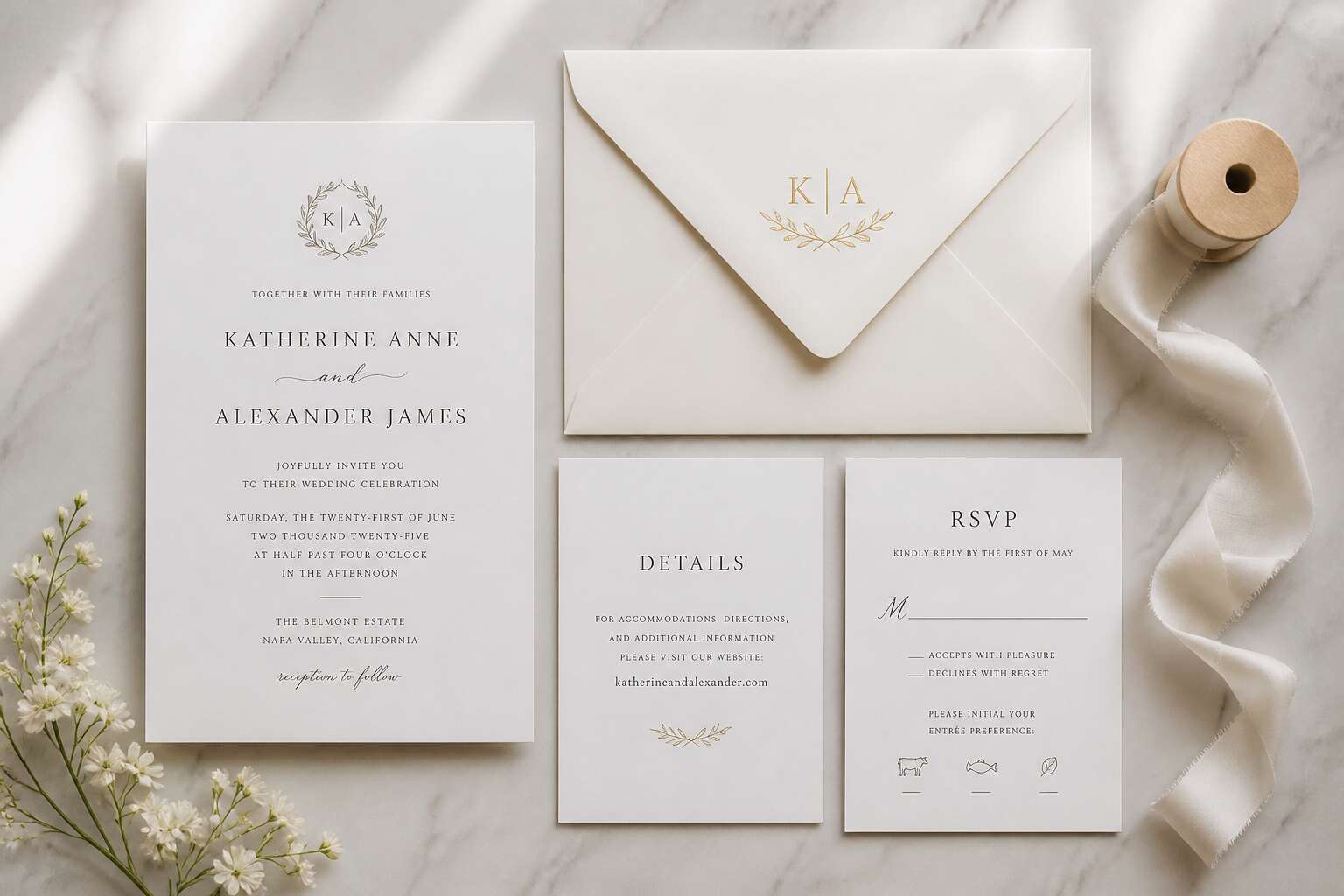
When a couple asks what is standard wedding invitation size, the answer rarely varies across Johannesburg, Durban, or Stellenbosch. The 5×7 inch invitation has dominated for generations, and for good reason. It measures a sensible 12.7 by 17.8 centimetres, a proportion that feels substantial in hand while remaining easy to post.
The format’s popularity rests on several pillars:
- It harmonises with nearly every envelope style, from pocket folds to classic liners.
- It leaves ample white space for calligraphy, wax seals, and even a tasteful map.
Beyond these practicalities, the 5×7 dimension creates a pleasant visual rhythm on a dining table. It refuses to disappear among the canapés. So when you wonder what is standard wedding invitation size, remember that this has become the default, and rightly so.
Understanding A-Series Envelope Sizes (A7, A6, A2)
Every invitation requires a matching envelope. What is standard wedding invitation size? The answer depends on your envelope’s dimensions. The A7 envelope, measuring 5.25 by 7.25 inches, holds a 5×7 card with ease. The A6, trimmer at 4.75 by 6.5 inches, fits a smaller 4.125 by 5.5 invitation. The A2, a slimmer cousin, fits a folded card of 4.125 by 5.5. Which one suits your stationery?
– A7: the prevailing standard, reliable for most formal invitations.
– A6: ideal for save the dates or intimate gatherings.
– A2: best for reply cards or casual notes.
These codes originate from the American sizing system, yet South African printers follow them widely. I have watched couples order incorrectly, then see their card rattle inside an A6. Measure the invitation first, then choose the envelope. Ask your supplier if you feel unsure. Standardisation simplifies the process.
Why 4×6 Remains a Budget-Friendly Standard
When couples ask what is standard wedding invitation size, they expect one answer. I have found the reality is more layered. For many South African weddings, 4×6 inches offers a budget friendly standard that deserves serious consideration.
This dimension matches the classic photographic print. Printers produce 4×6 in vast quantities, reducing per unit costs. The corresponding envelope is compact, keeping postage low. The card feels familiar in the hand, like a treasured photograph.
Consider the practical benefits:
– It fits standard photo frames and albums.
– It pairs naturally with a 4×6 engagement photo.
– It allows a simple fold for a booklet style.
The 4×6 invitation avoids special dies and oversized packaging. It moves through the postal system without surcharges. For couples planning a modest yet dignified wedding, this size delivers elegance without excess. This is why what is standard wedding invitation size yields a practical and affordable answer.
Square Invitations: Breaking the Mold with 5×5 and 6×6
Square invitations are the rebels of the wedding stationery world. Most couples asking what is standard wedding invitation size expect a rectangle. Square cards break that expectation with deliberate charm. The 5×5 and 6×6 dimensions create a canvas that feels less like mail and more like gallery art.
These sizes require square envelopes, and that is where the romance ends. Postage climbs. Sorting machines show no mercy to corners. A 6×6 card offers generous room for your details. The 5×5 version is more restrained, yet still striking in the hand.
Square invites come with trade-offs:
- Premium envelope sizes are harder to source locally
- Lining options are fewer
- RSVP cards need careful scaling
The square format suits couples who prize design over postal convenience. The standard answer exists, but it does not own the market.
Matching Sizes to Your Wedding Style and Theme
Formal Affairs: The Case for Larger, Opulent Sizes
In a formal wedding, the invitation sets the inaugural tone. Affairs of solemn grandeur demand larger sizes. While what is standard wedding invitation size often rests at 5×7, the opulent scale of 6×9 creates a deliberate unboxing ritual. The heavy stock, the resistant seal, the layered interior, all resist urgency.
- Multiple inserts for travel details
- Embossed emblems that need space
- An inner envelope inside a heavier shell
These features thrive with physical gravity. A modest size crushes them into disorder. For a candlelit cathedral or a manor banquet, choose the larger format. It signals permanence before the first word is read.
Casual and Backyard Weddings: Smaller and Simpler Options
Casual and backyard weddings ask for something lighter. The invitation should echo the setting, not fight it. When couples wonder what is standard wedding invitation size, the answer changes once the venue moves from a reception hall to a garden. Smaller formats suit barefoot ceremonies and picnic tables.
I prefer a simple design in these cases. No heavy cardstock. No wax seals. No layers to peel apart. The invitation becomes a practical object that guests can tuck into a pocket or hold while sipping something cold. For these occasions:
– Choose one card, not a suite
– Skip the reply card and use a website instead
– Keep the wording brief and direct
The size question resolves itself when you match the paper to the mood. A smaller card feels honest outdoors. It tells guests the wedding will be comfortable and personal. Understanding what is standard wedding invitation size helps, but the setting should drive your choice. The message matters more than the envelope!
Destination Celebrations: Compact Sizes for Traveling Guests
Destination weddings change the invitation equation. Guests are already packing passports, chargers, and comfortable shoes. The last thing they need is an ornate card that demands its own envelope, its own tissue paper, and a box to keep it safe. When the celebration happens far from home, the question of what is standard wedding invitation size gives way to a simpler concern: will this survive the journey?
A compact invitation, sized to slip into a passport sleeve or a cabin bag pocket, earns its place. It travels without fuss and arrives intact. For these occasions:
– Choose a single card, not a layered suite
– Print details on one side to avoid confusion
– Add a website link for updates on weather or transport
Travelers appreciate the restraint. The paper should feel like a practical companion, not another item on their packing list. When guests carry your invitation across provincial lines or international borders, the size should reassure them that this wedding will be effortless too.
Suite Coordination: Aligning Invitation Card, RSVP Card, and Details Card
Few decisions whisper your wedding’s character as loudly as the paper dimensions guests find in their mail. A sharp 5×7 rectangle suggests sleek modernity, while a generous oversized card immediately signals old-world formality. Before you ask what is standard wedding invitation size, consider what your venue and dress code are already telling guests. A vineyard ceremony in Stellenbosch calls for earthy textures and a straightforward shape, not a fussy square. A black-tie gala in Cape Town demands a heavier card, perhaps with a lined envelope, because the physical weight should mirror the evening’s significance.
When you assemble your suite, treat the components as a single visual unit. The RSVP card and details card should feel like siblings to the main invitation, echoing its scale. For a classic 5×7 main card, a 3.5×5 RSVP card keeps the balance clean. You want the collection to be cohesive when opened together, not a jumble of mismatched papers. The connection between pieces matters more than any individual measurement.
Here is a practical alignment to consider:
1. Use a 5×7 main invitation for most semi-formal and formal celebrations.
2. Pair it with a 4×6 details card for accommodation and travel information.
3. Keep the RSVP card at 3.5×5 to rest neatly inside the envelope.
This scaled approach creates a tactile hierarchy. Guests instinctively understand which card demands action and which offers guidance. The size of each piece directs their attention, making the entire experience intuitive.
The selection ultimately dictates the emotional tone before the first word is read. A heavy, oversized suite feels like a promise of grandeur. A compact, minimalist card suggests a close-knit gathering without pretense. The answer to what is standard wedding invitation size becomes less about a universal rule and more about the story your paper tells. Guests will hold that physical object for a few seconds, and those seconds shape their anticipation for the day itself.
The Influence of Color, Texture, and Paper Weight on Perceived Size
Nearly every couple asks what is standard wedding invitation size before they understand how much the paper itself shapes perception. Scale is not a neutral decision. It responds to venue, dress code, and the mood you want to set before the envelope is even opened. In South Africa, from a Winelands estate to a kloofside garden, the physical dimensions of your invitation are the first handshake with your guests.
Texture and weight make a 5×7 card feel either firm or flimsy. A lighter card stock can make a larger size feel cheap, while a heavyweight 6×6 square can overwhelm a small envelope. This interplay matters as much as the printed design.
– A soft, textured cotton card in a smaller size feels bespoke and intimate.
– A smooth, high-gloss finish on a larger card reads sleek and contemporary.
– A matte, fibre-rich stock adds visual bulk to a modest 4×6 piece without increasing its footprint.
Colour changes perceived dimensions too. A deep forest green or oxblood card seems heavier and more imposing than the same size in a pale neutral. Rich tones add visual weight, making a standard 5×7 feel more substantial in hand. Lighter colours against a plain inner envelope can make the piece feel airy and less formal. This is why a simple question like what is standard wedding invitation size rarely produces a single answer. The size, the texture, and the shade work together to tell a coherent story. The perceived grandeur of your suite rests as much on the tactile choices as on the centimetres. A compact card with deep colours and a heavy deckle edge can carry more gravitas than a large, thin card with a glossy print. Match the physical qualities to the emotional register you intend, and the standard size stops being a rule and becomes a starting point.
How to Choose the Right Size for Your Invitation Suite
Start with the Envelope: Working Backward from the Mailbox
The envelope is the first thing your guests touch, so let it guide your decision. Begin with what your postal service can handle. South African Post Office regulations have specific dimensions for machine sorting, which turns the question of what is standard wedding invitation size into a matter of physics rather than preference.
A standard envelope like A7 fits a 5×7 card with room for an RSVP card, making it the most common pairing. We always measure the full card stack first, including any embellishments, then match the envelope. A few millimeters of breathing room prevents crushed corners.
If your details card is thick, move up a size. Work backward from the mailbox to avoid disappointment on the wedding day.
Factoring in Insert Cards and Multi-Piece Suites
The question of what is standard wedding invitation size shifts when you add an RSVP card and a details card. A single 5×7 sits in an A7 envelope, but a thicker stack needs more room. Precision matters here.
I always measure the complete suite, including belly bands or vellum wraps, before choosing an envelope. The card sizes must harmonize visually and physically. A 4×6 details card paired with a 5×7 main card requires an envelope that fits both without bending.
- RSVP cards: 3.5×5, often with a return envelope.
- Details cards: 4×6 for accommodation and schedule.
- Response cards: add thickness, moving you to A9.
For a multi-piece suite, stack every component and measure thickness. Add 3 millimeters for breathing space. This protects corners and keeps postal sorting efficient. In South Africa, oversized suites get manual handling, which beats a crushed invitation.
Budget Considerations: How Size Impacts Printing and Postage
When brides ask what is standard wedding invitation size, they usually expect an aesthetic answer. Budget tells a different story. Printers calculate costs per sheet, so a larger card yields fewer cards per page. That difference compounds across hundreds of suites.
Postage adds another layer. South African postal rates climb once your envelope exceeds certain dimensions or thickness. A lightweight 4×6 suite mails affordably, while a heavy 6×6 with multiple inserts can double your postage budget.
- Printing costs rise with square footage, not just per card.
- Envelopes beyond A7 often require non-machineable stamps.
- Thick suites may need extra postage for manual handling.
Choosing the right size means weighing these costs before you fall in love with a design.
Digital Invitations vs. Physical Sizes: A New Standard?
When a couple asks me what is standard wedding invitation size, they often expect one answer. Digital invitations have fractured that simplicity. An e-card has no physical dimensions, so the size is whatever fits your screen. Yet the moment anyone prints that digital file, the old rules return.
Think about your actual guests.
- An uncle might prefer a paper suite to keep on the fridge.
- A cousin might only check the link you sent to her phone.
Digital invites skip postage, but they still need deliberate layout. A 5×7 design made for a phone screen can look mismatched on an A7 envelope. So the standard wedding invitation size now depends on your delivery method. That is the real standard, one shaped by the invitation’s journey from sender to recipient.
Aligning Your Choice with the Printing Method (Letterpress, Thermography, Foil)
Ink and paper do not bend to your preference. The printing method itself dictates the physical limits of your design. This is where size and process lock together. Letterpress uses deep plates that require a heavier cotton paper stock, which often means a robust 5×7 card to prevent warping. Thermography produces a raised resin that needs breathing room, so a cramped 4×6 can feel overloaded with text and texture.
Foil stamping is the most demanding. The metallic finish needs a stable, flat surface to adhere properly, which explains why many foil suites are printed on larger cardstock. For this reason:
– Choose a 5×7 card for letterpress to support the plate pressure.
– Pick a 4×6 or larger for thermography to avoid a cluttered look.
– Select a 5×7 or 6×6 for foil to prevent cracking along the crease.
Getting the answer to what is standard wedding invitation size is less about a rulebook and more about your chosen print process. The machinery has its own requirements. Your aesthetic preference must yield to those constraints. A design looks stunning on screen, but the physical print run tells the real story. Your standard size is the one that survives contact with rollers, plates, and foil. The final measurement is the one your printer approves without a sigh.
Requesting Physical Samples to Test Scale and Feel
Ordering physical samples settles what is standard wedding invitation size for your suite. When the sample arrives, hold it. Weigh it in your hand. Place it inside its envelope and see how the bulk sits. I promise, the scale of a 5×7 card feels different in real life than in a mockup on a laptop screen.
Your fingers catch details the eye misses. The grain of the paper. The flex of the card. A larger card demands a heavier paper stock to hold its structure. Others find a compact size feels more intimate once the suite rests in one palm.
When you request samples, check these details:
- The card’s weight and bend
- How the RSVP card tucks behind the main invitation
- Whether the envelope flap closes flat
The physical sample tells you what guests will feel when they open the envelope. That feeling guides your final choice!
Envelope Dimensions and Postage Essentials for Standard Sizes
The A7 Envelope: The Perfect Partner for 5×7 Invitations
What is standard wedding invitation size? For most stationery studios, the answer is 5×7, and the A7 envelope fits it perfectly. This envelope measures 5.25 by 7.25 inches, leaving a precise quarter inch margin. That space prevents bowing and keeps the mail piece flat.
Postage essentials depend on weight and thickness. A single 5×7 card in an A7 envelope typically weighs under one ounce, so a standard stamp works. Adding an RSVP card changes that calculation.
Several factors affect the final cost:
- Combined weight of every insert
- Envelope thickness beyond 0.25 inches
- Square edges, which trigger nonmachinable fees
The A7’s rectangular shape avoids those surcharges, keeping your invitations within standard postage rates.
Sizing Up Non-Standard Inserts: Business Cards, Folded Units, and Maps
Your invitation suite has a postal reality. Business cards, folded units, and maps turn a neat A7 envelope into a thicker object. So what is standard wedding invitation size? For most, 5×7 remains the anchor. Envelope dimensions guarantee fit, not weight class. A business card adds negligible bulk; a folded map can push the piece past one ounce. Thickness above 0.25 inches triggers surcharges, and odd shapes invite nonmachinable fees. Scrutinize each insert:
- Weigh every card
- Measure total thickness
- Confirm the flap closes flat
Then calculate postage with a scale. Non-standard inserts demand exact planning. The post office charges for every extra millimeter, so respect the A7’s quarter inch margin.
Avoiding Postage Surprises: Weighing Your Complete Suite
Postage rates depend on measured weight, not visual bulk. A standard 5×7 invitation fits an A7 envelope, but what is standard wedding invitation size does not answer every postal question. I always tell couples to weigh the complete suite before printing anything.
Weigh the assembled suite with every card, map, and folded unit inside. Measure thickness at the seam. Confirm the flap closes flat without strain. These three checks prevent expensive surprises.
- Weigh the full suite on a postal scale
- Measure total thickness with a ruler
- Test the flap’s closure under pressure
Postage increases when thickness exceeds 0.25 inches or weight passes one ounce. Odd shapes and stiff inserts add nonmachinable fees. For postage essentials, treat each envelope as a single object. A perfectly fitted envelope does not protect you from a heavier package. Every extra gram changes the rate, so double-check before you buy stamps.
Square Envelopes and Machineable Mail Surcharges
Square envelopes incur a postal surcharge. The South African Post Office, like many national carriers, classifies mail by its aspect ratio. A square envelope measures nearly equal on all sides, which pushes it outside the machinable range. A 5×5 square attracts a fee where a 5×7 rectangle does not. That distinction is part of what is standard wedding invitation size decisions often miss.
Machinable mail must satisfy several criteria:
- Aspect ratio between 1.3 and 2.5
- Legible address placement
- Flexible, bendable contents
Square envelopes fail the ratio test outright. They are nonmachinable. They need hand sorting, which adds a fee. Postage essentials for standard sizes begin with measuring length and width. I have seen couples assume a 5×5 envelope posts as cheaply as an A7. It does not. The A7, at 5.25 by 7.25 inches, clears the threshold comfortably. Square designs break that rule.
Hand-Canceling Versus Standard Mailing for Heavy Cardstock
Heavy cardstock changes the postage equation. A 5×7 invitation inside an A7 envelope may measure within standard dimensions, but its weight can push it into nonmachinable territory. The South African Post Office sorts mail by machine, and thick, rigid paper often jams the rollers. This is where hand-canceling enters the conversation. Hand-canceling means a postal worker manually stamps the envelope, bypassing the automated sorting line. It protects the card’s corners and prevents bending. It also costs more.
When you ask what is standard wedding invitation size, remember that dimension is only half the story. Standard mailing assumes flexibility. Heavy cardstock needs a rigid envelope or extra postage. Some couples choose a 5.25 by 7.25 envelope and still face a surcharge because the card exceeds 1.5 millimeters in thickness. The hand-cancel fee is small, but it adds up across 100 invitations. Compare that fee against the cost of lighter paper. The choice is practical, not aesthetic.
Frequently Asked Questions About Wedding Invitation Size Standards
Is 5×7 Always the Standard, or Are Other Sizes Acceptable?
Is 5×7 always the standard? Not at all! The term “standard” refers to the most common choice, not a rigid rule. What is standard wedding invitation size truly depends on your event’s tone, your budget, and the postal service you use. The 5×7 card remains popular because it pairs perfectly with the A7 envelope and offers ample space for your wording.
However, other sizes are perfectly acceptable. A6 invitations, for instance, are slightly trimmer and feel more intimate, while square cards like 5×5 make a bold statement. The key is ensuring your entire suite works together. If your RSVP card matches your main invitation in proportion and your envelope fits comfortably, any size can succeed.
So, before you settle, consider all dimensions. What is standard wedding invitation size for one couple may not suit another. Weigh your paper weight, postage, and personal style carefully.
How Small Is Too Small for an RSVP Card?
An RSVP card that is too small creates confusion. A 2×3.5 business card forces guests to squeeze their names and meal preferences into a tiny area. That leads to illegible handwriting and lost replies. For a practical minimum, I recommend 3.5×5 inches, which fits the A2 envelope and gives enough room for names, a checkmark, and an entrée selection.
When asking what is standard wedding invitation size, remember that the RSVP card should follow suit. A 4.25×5.5 card works well for most weddings. However, if your invitation is massive, a petite RSVP can feel mismatched. Always test by writing on a sample. If you struggle to fit your own response, it is too small.
Do Pockets or Belly Bands Change the Standard Dimensions?
Most couples assume a pocket or belly band forces a bigger invitation. It doesn’t. What is standard wedding invitation size stays the same. The invitation card itself remains your chosen dimension. What shifts is the envelope. A 5×7 invitation wrapped in a belly band still fits an A7 envelope, provided the band sits flat. Pockets with multiple inserts, however, add thickness. That thickness can push your suite into a larger envelope, even when the invitation card stays put.
When I help clients choose a pocketed design, I ask them to do three things:
- Measure the fully assembled suite, not the individual cards.
- Test one complete sample before ordering envelopes.
- Account for ribbon knots or clasps, which add surprising bulk.
These steps matter because what is standard wedding invitation size applies to the card itself. Pockets and belly bands are packaging, not the product. They should never dictate your card dimensions.
What Is the Biggest Size You Can Mail Without Extra Postage?
Most couples discover the postage limit when the counter clerk sighs and slides the envelope back. The biggest size you can mail without extra postage depends on length, weight, and thickness. In South Africa, the Post Office allows a standard letter up to 230 by 350 millimetres, 50 grams, and 5 millimetres thick. That is roughly a 9 by 14 inch envelope. So what is standard wedding invitation size, often 5×7, leaves ample room.
Yet a heavy cardstock or a layered insert can push your suite over the limit even when the card obeys what is standard wedding invitation size. A ribbon adds meaning and millimetres. The real test is the assembled package.
- Weigh the suite with every enclosure
- Measure thickness at the thickest point
- Send one test invite to your own address before mass mailing
How to Scale Insert Sizes for a Perfect Fit Inside the Outer Envelope
People often ask whether what is standard wedding invitation size must govern the entire suite. The answer is no, though logic should prevail. An RSVP card can be smaller, a 4×6 within a 5×7 envelope. A details card should never be wider than the invitation, or it invites a bend.
Scaling inserts for a perfect fit inside the outer envelope demands a ruler and a little arithmetic. Common pairings for a 5×7 invitation include:
- 4×6 RSVP card for a neat side-by-side tuck
- 5×6.5 folded directions card, closed
- 4.25×5.5 details card, leaving a narrow border
Any deviation from what is standard wedding invitation size requires that measurement. Printers and stationers have sample envelopes, and the wise couple tests every combination before ordering a hundred. It saves a great deal of muttering at the post office.
Common Sizing Mistakes to Avoid in Your Wedding Invitation Order
Overlooking the Exact Inner Dimensions of Your Envelope
Most couples focus on the outside of the envelope, where the postage stamp and address live. The true test of any wedding suite happens when you slide the inner card inside. Overlooking the exact inner dimensions of your envelope is a frequent error, and it throws off the entire measurement journey.
If you are asking what is standard wedding invitation size, the answer often revolves around the outer card. The interior space is slightly smaller due to the envelope’s seam and flap. A 5×7 card sits snugly inside an A7 envelope, but a thick, layered card adds bulk. That card needs a few millimetres of breathing room.
- Measure the interior depth with the envelope fully sealed.
- Account for the card’s thickness, not just its width and height.
- Test with the exact paper weight you plan to use.
Envelope manufacturers cut the paper using standard templates. The glue and folds reduce the usable area. When in doubt, order a sample envelope first. It saves you from reordering the entire suite later. The satisfaction of a perfectly fitted card is worth the extra step.
Assuming All Card Stocks Are the Same Thickness
Assuming all card stocks are the same thickness causes more missteps than almost any other detail in a wedding suite. When you ask what is standard wedding invitation size, the answer only covers length and width. Two 5×7 cards can look identical on paper yet differ dramatically once printed, because a 350gsm textured stock runs far thicker than a 250gsm smooth sheet. The perceived size changes, the weight changes, and the way the card sits inside a pocket or belly band changes too.
This mistake appears most often when couples order online. A digital mockup shows the same flat rectangle for every paper option. The mockup cannot convey how much space the card actually occupies. So while the dimensions of what is standard wedding invitation size remain constant, the stock you choose can turn a perfect fit into a forced squeeze.
Forgetting the Extra Millimetres for Stacked Cards
You have measured your 5×7 invitation to the millimetre. Then you slide in an RSVP card, a details card, and maybe a map. Your envelope now bulges. Forgetting the extra millimetres for stacked cards is the mistake that turns a chic suite into a postal emergency.
Here is the thing: when you ask what is standard wedding invitation size, the answer only describes each card in isolation. The moment you stack three or four pieces, the combined thickness can exceed your envelope’s inner capacity. Common culprits include:
- Double-thick RSVP cards with rounded corners
- Details cards printed on heavy cotton stock
- Wax seals or ribbon closures that add bulk
Each element may look slim on screen, but in physical form they demand extra millimetres. Always measure your complete stack before ordering envelopes, or you will face the awkward task of ironing your wedding stationery.
Choosing a Design That Forces an Awkward Envelope Size
When you ask what is standard wedding invitation size, the answer usually points to 5×7, but design can pull you toward something else. I have seen gorgeous hexagonal invitations that require bespoke envelopes, turning a simple mailing into a custom order. That adds cost and delay.
Avoid any shape that lacks a ready-made envelope match. Consider these awkward pairings:
- A 6×9 card with a 7×10 envelope, which violates postal ratios
- An oversized 8×8 square that needs a 9×9 enclosure, a rare size
These choices force you to hunt for specialty suppliers. Sticking with standard sizing keeps your stationery practical and elegant.
Ignoring Mailing Standards in Your Country
South Africa’s Post Office has firm ideas about what is standard wedding invitation size. You can order a perfect 5×7 suite from an international site, but if your envelope exceeds the length to width ratio limits, the sorting machine will spit it back. Nobody wants a returned invitation wearing an undeliverable sticker.
Common local errors include:
- An envelope that is too deep for its length
- A card stack that pushes total thickness past 5mm
- A square shape that requires hand sorting and extra fees
I always ask the printer what is standard wedding invitation size for local mailing. The answer depends on our postal regulations, which differ from overseas rules. Verify the aspect ratio against the SAPO guide before you approve the proof. Ignoring local standards turns a simple mailing into a courier exercise.


0 Comments