Cultural Significance of Xhosa Wedding Ceremonies
In Xhosa culture, a wedding is a sequence of communal rituals rather than a fleeting ceremony. The xhosa wedding invitation serves as the first formal summons, calling relatives to witness the uniting of two families. It carries symbolic gravitas, often indicating where lobola is exchanged and which ancestors will be praised. Elders study these details closely. They know each element demands specific blessings. An xhosa wedding invitation might highlight:
- the evening of song before the main day
- the dawn ritual introducing the bride to her new home
- the final feast shared by both clans
This ensures guests arrive prepared for their role in preserving harmony.
Essential Elements of a Traditional Invitation
In my years attending weddings across the Eastern Cape, I have learned that a single xhosa wedding invitation can silence a whole room. The elders read it aloud. They check every line for respect. One mistake, and the union begins with distrust.
Several elements must appear. Without them, the card fails its purpose.
- The paternal clan praise of the groom
- The bride’s own family totem
- The appointed date for the negotiation ritual
- The name of the negotiating elder
This is what separates a true traditional invitation from a plain announcement. The xhosa wedding invitation carries the ancestors’ presence. It is not a formality. It is a contract, finalized with ink.
Writing the Invitation Text: Etiquette and Customs
A Xhosa wedding invitation embodies an oral tradition. Every phrase must honour the families, and the wording often begins with a respectful greeting to the ancestors. This is where etiquette shapes your prose!
- Address both families by their clan names.
- Use formal language for the elders.
- State the date, venue, and ceremony order clearly.
When I craft these invitations, I always remember that brevity offends no one, but omission does. The invitation text should read like a friendly yet dignified speech, inviting guests to witness the union without losing warmth.
Design Ideas and Inspirations
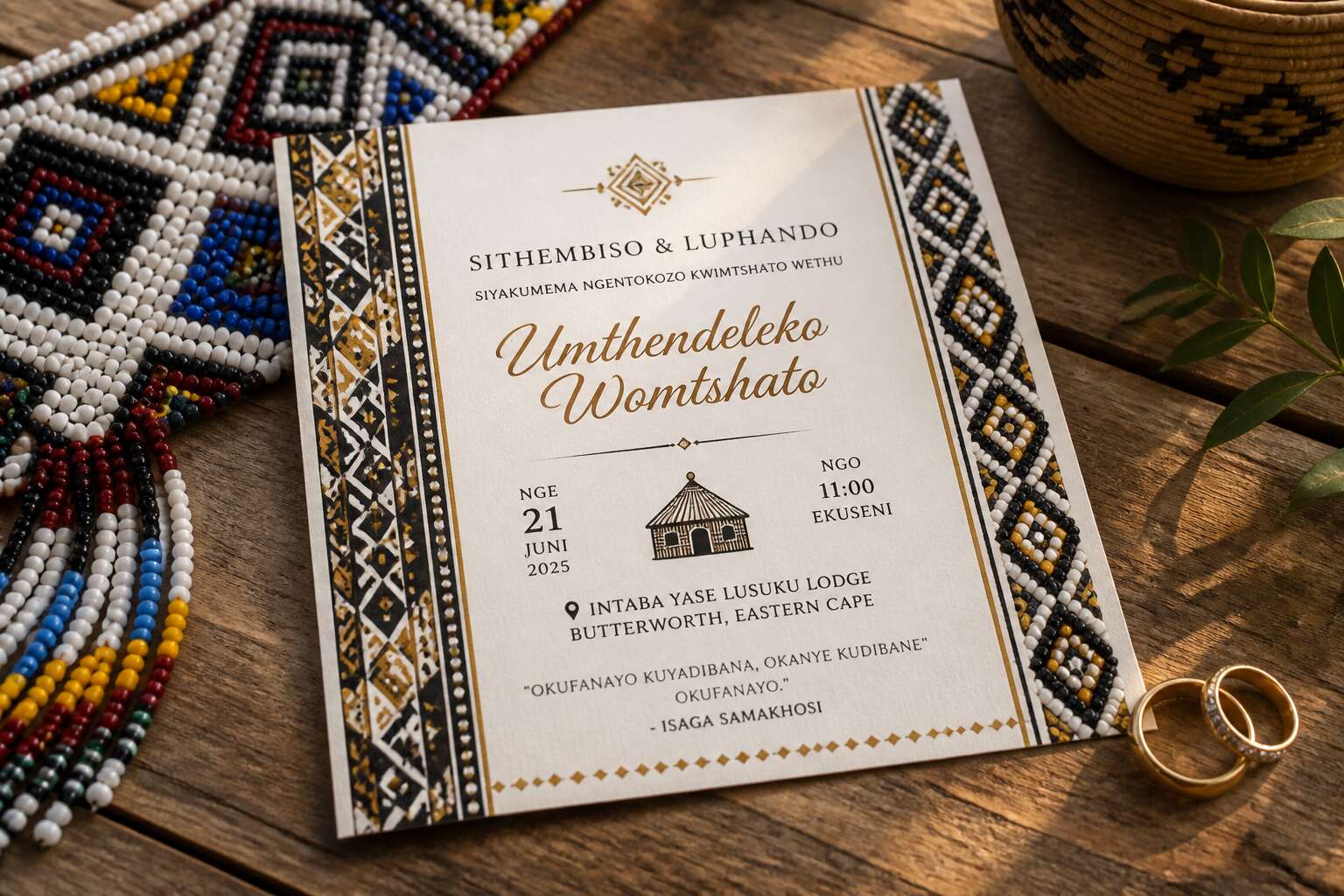
The design of a xhosa wedding invitation is a visual prelude to the ceremony. It carries the family’s heritage through its colour palette, often mirroring the bride’s traditional blanket. I have seen invitations use the deep umber of the earth and the bright sky blue of ceremonial beadwork. The paper’s texture can recall woven blankets.
For deeper inspiration, consider these elements that appear in memorable designs:
- The clan name, letterpressed in a bold serif.
- A geometric motif from the bride’s top blanket.
- A subtle watermark of the brewing pot.
When you personalise a xhosa wedding invitation, focus on the couple’s story. Some prefer a modern minimal look with a single beadwork stripe. Others choose a fully illustrated scene of the homestead, complete with cattle and the great tree. The choice is personal. A well crafted example becomes a cherished keepsake that embodies ubuntu before the first word is read.
Digital Invitations and Modern Alternatives
More couples are trading the hefty, formal paper stock for something that pings straight onto a phone. The shift to digital invitations and modern alternatives is not about losing tradition, it is about adapting its delivery. When you coordinate a Xhosa wedding invitation alongside umembeso or the white wedding, the sheer logistics can overwhelm even the most organised families. A digital version offers instantaneous access to venue maps and dress codes, which is a pragmatic relief for guests travelling from across the country. It also slashes the cost of printing and postage, freeing up budget for the catering or the live band.
The real beauty of this approach is the interactive space it creates. You can embed a photo gallery of the couple or a short video message from the elders, something paper can never convey. For the guest list, the practicality is undeniable:
– Real-time RSVP tracking to manage seating with accuracy.
– Instant updates for schedule changes or transport details.
– A direct link to the wedding registry for those who ask.
While the tactile feel of a calligraphed card is undeniably romantic, the modern alternative holds its own kind of weight. It is immediate, efficient, and often more engaging for the younger generation in the family. A digital Xhosa wedding invitation does not diminish the ceremony’s significance. It simply ensures the message gets there, on time and in full colour, without relying on a postal system that might let you down. The core element remains the same: bringing people together to witness something sacred.


0 Comments