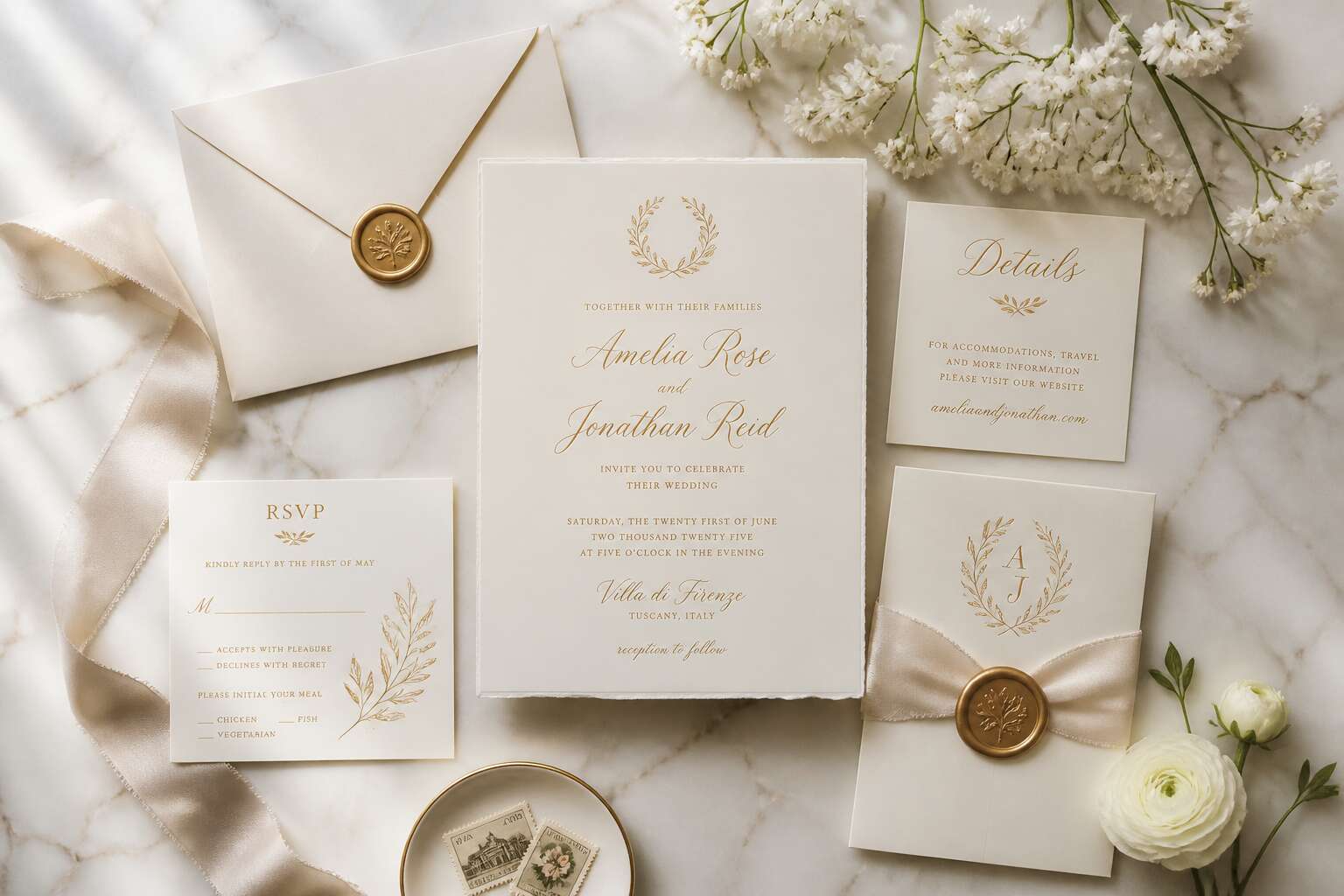
Essential Elements for Every Invitation
The Host Line and Who Is Listed First
Deciding who hosts the wedding is the first fork in the road for your wedding invitation wording. Convention says the couple’s parents host, but modern South African families often share the honour. When both sets of parents contribute, list the bride’s parents first, then the groom’s parents. If divorced parents are involved, list the parent who raised the child or hosted the wedding. Place the new partner’s name only if that person helped pay.
For the names themselves, use full legal names or titles. Avoid nicknames unless the couple is famously known by them. In same-sex weddings or when the couple hosts themselves, simply write “together with their families” or list both names alphabetically. This choice shapes every line of your wedding invitation wording.
Common arrangements include:
1. Bride’s parents alone
2. Both sets of parents
3. The couple alone
4. Divorced parents with new spouses
Each option sends a clear signal about who carries the financial weight. Choose the one that reflects your actual situation.
Formatting the Date, Time, and Location Correctly
The date is the one line every guest actually reads, so get it right. In South Africa, we often spell out the date in full to avoid confusion between day and month. For example, write “the third of October” rather than “10/3” which could mean March tenth in other countries. Time and location demand the same care. If your ceremony starts at 2pm, say so clearly. Include the venue name, street, and suburb. For farm venues, add a landmark. I once saw an invitation that said “gates open at 3pm” but no venue address beyond the farm name. The best wedding invitation wording treats these details as non-negotiable. Here are the essentials you cannot skip:
– Spell out the year fully.
– Include the province if the venue is outside a city.
– Specify if the time is for the ceremony or for the reception.
Your wedding invitation wording should leave no room for guessing. Getting the formatting right is your first courtesy to them.
Including Reception and Additional Event Details
Statistics show that nearly a third of guests consult the invitation repeatedly for reception logistics. Wedding invitation wording must therefore cover every event beyond the ceremony. If the reception happens at a different venue, say so plainly. Include the time dinner is served and whether the bar is cash or hosted. For a wedding weekend, guests need to know about the Friday welcome braai and the Sunday farewell breakfast. List each event separately.
Here is what to include for each event:
- Event name and time
- Exact venue or meeting point
- Dress code or specific instructions
- Any transport arranged
Once these details appear clearly, guests feel prepared. Your wording should also mention if children are invited to the evening reception only. This level of specificity prevents dozens of follow-up messages. The best wedding invitation wording treats the whole celebration as a sequence, not a single moment.
Dress Code and RSVP Wording Basics
Surveys indicate that more than half of guests re-read their invitation for dress code and RSVP details. A request for ‘smart dress’ means something different on a Durban beachfront than at a Johannesburg country club. Your wedding invitation wording must name the expected attire with precision. Specify ‘garden formal’ or ‘cocktail attire for a lawn reception.’ For multi-event weekends, list each dress requirement per event.
RSVP wording demands clarity. State the reply deadline in absolute terms, such as ‘by 15 March,’ and name the exact response method. Whether guests reply by email, phone, or your wedding website, the instruction must be unmistakable! Ask each invitee to confirm by name.
Common phrasing options for attire:
- Smart casual: pressed chinos with a collared shirt
- Black tie optional: dark suit, cocktail dress
- Garden attire: sundresses and linen suits for grass
The best wedding invitation wording treats dress code and RSVP as essential preparation.
Traditional Formal Wording Options
Classic Religious Wording and Scripture Passages
There is a particular reverence in choosing words that have echoed through centuries of ceremonies. Classic religious wording for wedding invitation wording carries a weight that modern phrasing often cannot replicate. It offers a sense of solemnity, a connection to something greater than the couple themselves, and a formal grace that feels both majestic and intimate. Many couples find that this traditional approach provides the perfect foundation for their most sacred announcement.
One of the most beloved elements of this style is the incorporation of scripture passages. These verses frame the union as a blessing, acknowledging the divine hand in the relationship. Couples often choose from passages that speak to love’s endurance, such as 1 Corinthians 13, or the gentle commitment found in Ruth 1:16. The Book of Ecclesiastes, with its poignant image of a threefold cord not quickly broken, is another frequent and profound selection. This practice elevates the invite from a simple notice of logistics to a testament of faith.
Within this traditional framework, the opening line sets a distinctly hallowed tone. The phrasing is deliberate and ceremonial, leaving no room for ambiguity. A few classic structures remain timeless:
- Together with their families, [Bride’s Name] and [Groom’s Name] request the honour of your presence…
- In the presence of God, and with joy, [Bride’s Name] and [Groom’s Name] invite you to celebrate their marriage…
- With grateful hearts, we, [Parents’ Names], invite you to witness the marriage of our children…
These options always feel appropriate for a service held within a church, chapel, or temple. They set an expectation of a sacred event, where the exchange of vows is a spiritual covenant rather than just a legal agreement. The language prepares your guests for the gravitas of the occasion, asking them to participate not merely as spectators, but as witnesses to a holy promise.
However, weaving scripture into your reception details requires a delicate hand. If you are hosting a particularly secular reception afterwards, you can maintain the religious formality for the ceremony card while using simpler language for the party. This separation ensures the sanctity of the service is preserved in the messaging, while still conveying the joy of the celebration. The key is to let the religious text carry the emotional core, which then allows the practical details to remain clear and unobtrusive. This balance creates a lovely harmony that will resonate deeply with you and your guests.
Single-Line Invitations for Couples Hosting Together
Emily Post once called the single line invitation the most exacting form of wedding etiquette. This is wedding invitation wording with no room for error. When a couple hosts their own wedding, the phrasing must carry everything. There is no parent host line to share the weight. No secondary details to soften the message. Only one clean sentence, and every guest will feel its weight.
The traditional structure is precise. Both partners use their full legal names. They follow with ‘request the honour of your presence.’ Then comes the date, the hour, and the venue in a single continuous flow. For example, [Bride’s Full Name] and [Groom’s Full Name] request the honour of your presence at their marriage on Saturday, the fifteenth of February, at five o’clock in the afternoon.
- Use both full names exactly as they appear on the marriage certificate.
- Keep the venue within the same sentence to preserve the single line effect.
In South Africa, this format remains the purest choice for couples hosting independently. The wedding invitation wording is direct, timeless, and entirely their own.
Honorifics and Full Names in Formal Etiquette
Formal etiquette insists on full legal names, and it polices honorifics with the same rigor. For most couples, no titles appear before their names. The bride and groom are announced simply as Anna van der Merwe and Pieter Botha. Yet a doctor, a professor, or a military officer may claim a title. That choice affects the rhythm of the entire line.
Consider the traditional forms:
- Mr. and Mrs. for married parents hosting the event.
- Dr. for a physician or academic, full name follows.
- No honorific for the couple, unless a title is earned and preferred.
The rule is consistency. If one partner uses a title, the other should follow suit or remain equally bare. This is wedding invitation wording at its most formal: every syllable signals rank, respect, and clarity. A misapplied title creates doubt. Read it aloud twice. You will feel the difference!
Evening Weddings and Formal Request Phrasings
Evening weddings change the register of every word on the card. The wedding invitation wording for a night ceremony must match the solemnity of the hour, and formal request phrasings have long carried that weight. “Request the honour of your presence” signals a church wedding or a black-tie reception. The lighter “request the pleasure of your company” suits a garden party or an afternoon affair.
The distinction is traditional but still practical:
- “Request the honour of your presence” for religious or formal evening ceremonies.
- “Request the pleasure of your company” for relaxed daytime events.
Then state the hour with matching ceremony: “at seven o’clock in the evening,” never “at 7 PM.” The night demands its own decorum, and the wording should rise to meet it. Read the line aloud twice. You will feel the difference!
Traditional Response Wording and Reply Cards
A wedding invitation built on traditional formal wording never asks a question. It states the facts and trusts the guest to respond accordingly. “The favour of a reply is requested” remains the standard phrase, and it works because it implies courtesy rather than obligation. I have always appreciated how this line spares everyone the awkwardness of a loose deadline.
For those who prefer a more direct tone, “Kindly respond by the first of May” carries the same weight with less ornament. The traditional response card mirrors the wedding invitation wording exactly.
- Accepts with pleasure
- Declines with regret
- Kindly receives the invitation
Each line is written in the third person, matching the invitation’s voice. The invitation’s own phrasing does not transform on the reply card; it simply continues the same register. That consistency tells the guest the occasion will honour its own promises!
Modern and Casual Phrasing Ideas
Short Minimalist and One-Line Invites
Somewhere between the formal request and the wedding hashtag, there is a simpler style. Couples in Cape Town are swapping calligraphy for bold type. You can say a lot with one line, and that line says who you are.
Take the wedding invitation wording down to one line. Married on 3 March, come eat braai with us. Done. That is the whole invite. It works because the tone is set before anyone opens the door. Casual phrasing is not sloppy, it is intentional. You still need the date, time, place, and the names involved, but you can wrap them in a voice that sounds like you.
Consider these minimalist phrasing ideas:
- Say ‘let’s get married’ instead of ‘request the honour of your presence’
- Trust the GPS, no map needed
When you simplify the wedding invitation wording, you make the message clearer.
Playful Language and Themed Invitations
Playful wedding invitation wording thrives on shared context. When you and your guests know the same songs, the same slang, or the same silly phrase from a holiday, use it. Themed weddings benefit most, since the language can mirror the setting. A barnyard bash can say “dress for dust,” while a Gatsby night asks for “feathers and fringe.”
Some ideas for the playful route:
- Swap “requests the honour” for “clears the calendar”
- Ask guests to “bring their two-step” instead of listing a DJ
The wording stays strongest when the core details remain plain. Date, time, venue, names. Everything else can shimmer. Your wedding invitation wording is a preview, not a puzzle.
Wording for Digital Save the Dates and Websites
Digital save the dates exist in a transient realm, a short pause before the formal invitation arrives. Modern phrasing for these screen-based notes leans on directness, stripping away ceremony. For a wedding website, the wedding invitation wording often relaxes into conversational fragments.
Some couples prefer a list of essentials to full sentences:
- Names and date in bold
- City and venue link
- One line of tone, such as ‘Come as you are’
This approach has its own elegance. It tells guests the ritual remains, only the language has loosened. From my own experience, a simple ‘Save the seventh for us’ works better than any flourish! The tone should match your actual wedding, not a stranger’s idea of formality.
Navigating Family Dynamics and Special Circumstances
Divorced Parents and Multiple Hosts
When the marriage ends, the guest list begins its own negotiation! Divorced parents and multiple hosts present a vexed cartography for the wedding invitation wording. The central question is rarely finance; it is the arbitration of belonging.
You can list hosts alphabetically, or group them by generation. Stepparents who have earned their place must be named, not erased.
- List both parents on one line for mutual ground.
- Place the primary host first, then the secondary.
- Use “Together with their families” to bypass rank entirely.
That last phrase dissolves the need to rank affection. In my experience, the most harmonious wedding invitation wording for blended households allows every relative to see their own name reflected without a spotlight.
Including Step-Parents and Blended Family Names
Step-parents hold an unusual position in wedding invitation wording. They stand close enough to deserve recognition, yet etiquette books rarely speak their language. Name them plainly, with full names and the same honourifics as any other parent. In my experience, this small gesture matters deeply.
Blended families require careful coordination, not erasure. A father and stepfather may both walk the aisle. List the mother and her current husband as hosts, then include the biological father on a separate line. Order signals sentiment, so choose deliberately!
- Use “Mr. John Smith and Ms. Jane Doe” for biological parents who host jointly
- Include step-parents with their partner’s name on the same line
Each name appears once, in a form that matches their role. The wedding invitation wording for a blended family should not force a verdict on who matters more. It can simply acknowledge all the people who raised the couple.
Honoring Deceased Family Members in Invitations
The dead do not vanish from a wedding; they linger in the wording. Honouring a deceased family member without turning the invitation into a memorial requires precision. Your wedding invitation wording can acknowledge absence without dwelling on it.
For a parent who has passed, place “the late” before their full name in the host line. If both deceased parents would have hosted, use “The late Mr. John Smith and the late Mrs. Jane Doe.” Alternatively, a separate line reading “In loving memory of…” appears beneath the hosts.
Common routes include:
- Insert “the late” with the deceased parent’s name
- Add a dedicated memorial line
- Include a small symbol, such as a star, next to their name
Each option carries different weight. Pick one and apply it consistently within the full invitation suite.
Same-Sex Couples and Gender-Neutral Language
According to Statistics South Africa’s 2022 civil union data, same-sex marriages now account for over 2% of all registered unions. The language on your wedding invitation wording should mirror the respect you demand from your guests.
For same-sex couples, the traditional host line can feel restrictive. Use both names in the request line, such as “Together with their families, Thabo and Sipho request the pleasure of your company.” Gender-neutral options like “partners in life” or “beloved” retain elegance without presuming roles.
Ordering names presents its own deliberation. Choose one method and stay with it:
- Alphabetical by surname
- Chronological by the proposal date
- Simply the names in the order they feel most true
When addressing guests, “Mx.” offers a gracious solution for those whose honorifics remain unspecified. Your wedding invitation wording establishes the atmosphere before any guest reads the details. Let it welcome everyone without exception!
Coordinating Wording for Additional Cards
Reception Card Wording and Format Choices
South African couples often overlook the reception card, yet it holds the evening’s practical details. This small enclosure must mirror the ceremony’s tone while giving clear directions. A garden wedding at a wine estate calls for “Dinner and dancing under the stars.” A formal hotel affair might simply state “Reception to follow.”
The wedding invitation wording establishes the formality, so the reception card should feel like a natural extension. Format choices vary. You can use a separate card, a folded insert, or a combined sheet. Choose what fits your stationery suite!
– Match the paper stock and font of the main invitation
– Keep the reception card smaller so it tucks neatly inside
– Use the same phrasing style, whether formal or playful
When the wedding invitation wording pairs elegance with clarity, guests understand both the logistics and the mood. The reception card is not a mere technicality. It shapes the guest’s expectations for the celebration.
RSVP Card Phrasing, Meal Selections, and Deadlines
The RSVP card handles the administrative side of your wedding invitation wording. South African guests need clear instructions, especially when meal selections are involved. A vague “kindly respond” leaves everyone guessing about what to write.
The RSVP card phrasing should mirror the invitation’s tone while staying unambiguous. For meal selections, list options with checkboxes or a line for initials. Deadlines matter. Give guests three to four weeks before your final count, and state the reply-by date in plain language.
Consider these essentials when coordinating your RSVP card:
- Use a reply-by date that allows catering numbers to be confirmed
- Offer meal options that are clearly described, including dietary symbols
- Include a space for allergies if your venue can accommodate them
The wedding invitation wording sets the tone, while the RSVP card delivers the numbers. Keep both aligned in style and intention.
Details Card Wording for Travel and Accommodations
Travel and accommodation details deserve a separate details card, not a cramped paragraph on the main invite. Your wedding invitation wording should guide guests to the practicalities without overwhelming the ceremony information. For destination weddings in the Winelands or coastal towns, a details card can list airport transfer options, recommended hotels, and shuttle times.
Guests appreciate clarity when navigating unfamiliar areas. South African venues often require specific directions. A details card keeps the main invitation elegant while answering the unspoken questions.
Include these on your details card:
– Hotel booking codes and deadline dates
– Airport transfer arrangements
– Parking or ride-share notes
– Local contact numbers
This approach keeps your wedding invitation wording cohesive and your guests informed of the logistical essentials. The separate card allows the main invitation to remain focused on the celebration itself.
Dress Code Cards and Black-Tie Attire Notes
A separate dress code card signals respect for your guests’ planning time. Black-tie attire notes belong there, not buried in ceremony text. Your wedding invitation wording should remain graceful while the secondary card clarifies expectations.
For a formal Winelands wedding, state dress requirements explicitly. Ambiguity creates stress. Guests want to know whether a tuxedo is mandatory or a dark suit will suffice. Use precise terms and commit to them.
Common black-tie terms to include:
– Black tie: floor-length gowns and tuxedos
– Black tie optional: dressy separates acceptable
– Festive black tie: colour encouraged
The additional card gives guests permission to prepare properly, and that thoughtfulness carries into the celebration itself. When everyone arrives dressed in alignment, the room feels cohesive and the evening flows with fewer distractions.
Welcome Event and Post-Wedding Brunch Invitations
Coordinating the welcome event and post-wedding brunch requires its own rhythm. Your wedding invitation wording sets the ceremony’s tone, but the ancillary gatherings need a different approach. A welcome card might read “Join us for sundowners on the verandah” while the brunch card says “A final farewell over coffee and croissants.” The key is consistency. Use the same names, the same time format, and the same level of formality across all cards. Your wedding invitation wording should also govern these smaller cards.
Consider these phrases for the additional cards:
- “We would love to see you the evening before”
- “Celebrate with us at a morning after breakfast”
- “Join the wedding party for a relaxed poolside gathering”
Each line should match the invitation’s tone. If the main invite is formal, don’t suddenly become casual on the brunch card. That disconnect confuses guests and diminishes the elegance you have worked to establish.
Common Wording Mistakes and Etiquette Pitfalls
Apostrophe Errors and Capitalization Mistakes
Wedding invitation wording often stumbles on the smallest details. Apostrophe errors sneak in when couples write “The Jones’s” instead of “The Joneses” for a family name. Capitalization mistakes appear when “the honour of your presence” gets a capital T on “The” after a comma. These slip ups distract from the elegance you want to convey.
- Using an apostrophe for plurals, as in “the Smith’s” for the Smith family.
- Capitalizing “R” in “reception” when it follows a comma.
- Writing “your’s” instead of “yours” in RSVP wording.
Each error chips away at the polish of your wedding invitation wording. A proofread by someone who knows grammar can catch these before your guests see them.
Tone Mismatches Between the Invitation and Wedding Theme
A wedding invitation sets expectations long before the venue doors open. When the wording clashes with the theme, guests feel confused before they even RSVP. A barn dance wedding with silver-engraved formal script undermines the relaxed mood. Conversely, a city black-tie gala described as “casual drinks in the garden” leaves guests underdressed.
Tone mismatches in wedding invitation wording often appear in these forms:
- Overly flowery language for a minimalist beach ceremony.
- Inside jokes that alienate older relatives.
- Demanding gifts in the invitation text instead of pointing to a registry website.
Etiquette pitfalls surface when couples prioritize cleverness over clarity. A dress code reading “wear something fancy, no jeans” reads as flippant. The wedding invitation wording should mirror the event’s spirit while remaining precise. A mismatch creates awkwardness, not anticipation.
Including Too Much Text or Too Many Details
Guests do not need the full weekend itinerary. They need the venue, the date, and the RSVP deadline. Wedding invitation wording loses its purpose when it tries to tell every story at once. Save the personal anecdotes for the speeches.
Too many details create practical problems. A guest scanning for parking instructions might miss the actual ceremony time. The main invitation should carry only core information. Everything else belongs on a details card or the wedding website.
Common mistakes include:
– Reproducing the entire menu on the invitation
– Adding a biography of the couple or the wedding party
– Writing directions to the venue in paragraph form
– Including the dress code inside the main body text
The wedding invitation wording should remain lean. Each sentence must earn its place. Guests should leave the envelope knowing the essentials and nothing else.

0 Comments